

Across the glittering coastline of South Florida, a distinct architectural shift is reshaping the skyline. Miami waterfront condos are growing not only taller and more sculptural—but wider within. Developers are rethinking proportions, prioritizing expansive living zones that celebrate light, water, and social life. The result is a new standard of spatial generosity defined by open-plan luxury living rooms that blur boundaries between interior and horizon.
This evolution reflects more than aesthetic preference. It signals deeper Miami real estate trends shaped by global wealth migration, hybrid lifestyles, and a refined understanding of how luxury condo interior design supports contemporary living. For architects, interior designers, and high-net-worth buyers, larger living areas are no longer a design flourish—they are a strategic imperative.
The Evolution of Miami Waterfront Living
Historically, residential towers along Biscayne Bay and the Atlantic coastline emphasized panoramic bedrooms and compact formal salons. Today’s buyers, however, approach property differently. International investors—from New York and São Paulo to London and Dubai—seek primary residences rather than seasonal pieds-à-terre. In response, Miami waterfront condos are increasingly conceived as full-time homes.
Developers now analyze lifestyle patterns with greater precision. Research from the Urban Land Institute highlights how luxury residential demand has shifted toward adaptable, experience-driven interiors. This insight resonates strongly in Miami, where entertaining, wellness, and seamless indoor–outdoor living define aspirational life.
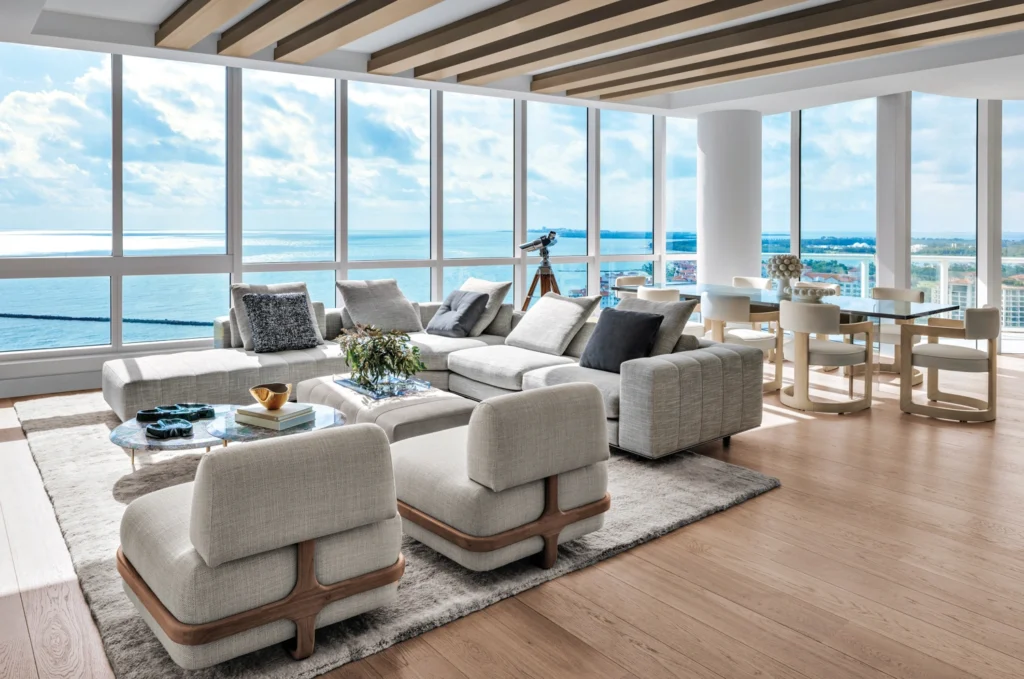
From Formal Rooms to Expansive Social Landscapes
The compartmentalized floor plans of previous decades have given way to fluid spatial compositions. In contemporary luxury condo interior design, walls dissolve, sightlines extend, and living areas expand to embrace terraces and water views.
Why? Because the living room has become the emotional and functional nucleus of the home.
- Entertaining at scale: International owners host art gatherings during Art Basel, yacht-viewing soirées, and philanthropic dinners.
- Integrated lifestyles: Work-from-home, wellness rituals, and family life coexist in one refined environment.
- Visual continuity: Larger footprints maximize the impact of floor-to-ceiling glazing and ocean panoramas.
As a result, open-plan luxury living rooms in Miami waterfront condos now frequently exceed 800–1,200 square feet—dimensions once reserved for entire apartments.
Market Forces Driving Larger Living Areas
1. Global Buyer Expectations
Affluent buyers relocating from major capitals are accustomed to grand entertaining spaces. They compare Miami offerings with penthouses in Manhattan, London’s Mayfair, or Dubai Marina. To remain competitive, developers respond by scaling up living areas within Miami waterfront condos.
This is one of the most visible Miami real estate trends: spatial scale as a differentiator.
2. The Post-Pandemic Redefinition of Home
The pandemic permanently altered spatial priorities. Homes became offices, gyms, screening rooms, and sanctuaries. In Miami’s prime towers, architects absorbed this lesson by enlarging primary living zones rather than multiplying small, enclosed rooms.
In high-end luxury condo interior design, adaptability now matters as much as aesthetics. Expansive living areas accommodate:
- Flexible seating arrangements.
- Discreet workstations integrated into millwork.
- Art walls for museum-scale collections.
- Zones for meditation or wellness.
Open-plan luxury living rooms offer elasticity without sacrificing elegance.
3. The Power of the View
Water is Miami’s ultimate luxury. Larger living areas allow architects to choreograph uninterrupted visual corridors toward Biscayne Bay, the Atlantic Ocean, and the Intracoastal Waterway. In premium Miami waterfront condos, glazing often spans 10 to 12 feet in height, demanding generous interiors that balance proportion.
Spatial amplitude ensures that the architecture does not compete with the view—but frames it.
Design Intelligence Behind Expansive Living Rooms
Increasing square footage alone does not guarantee success. The most sophisticated luxury condo interior design projects rely on careful orchestration of scale, acoustics, and materiality.
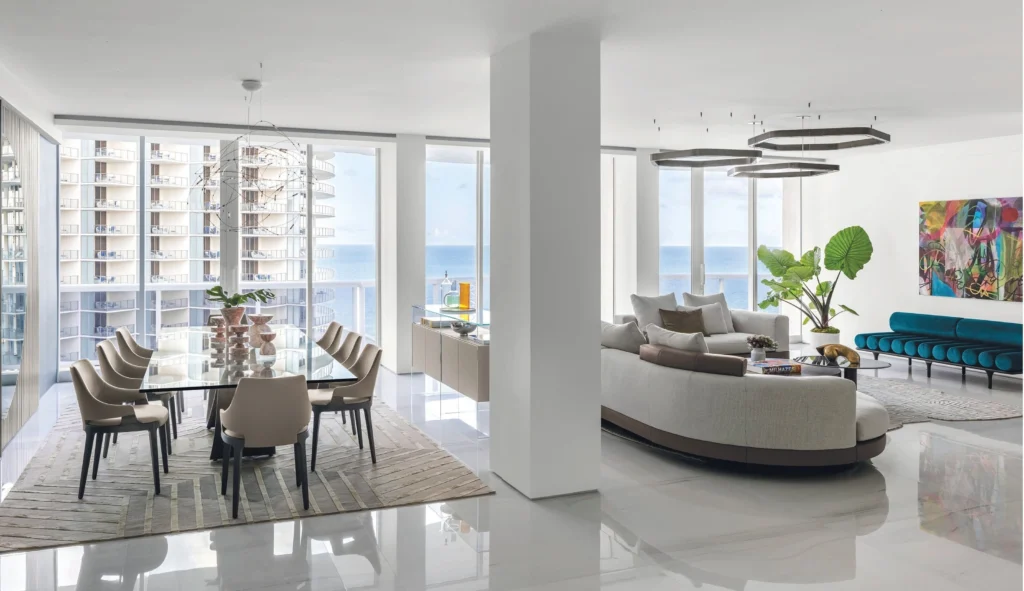
Proportion and Human Scale
Architects must prevent vast living areas from feeling cavernous. This is achieved through:
- Layered ceiling treatments.
- Sculptural lighting installations.
- Curated furniture groupings.
- Architectural millwork that subtly defines zones.
Premium brands such as Nolita Harbour understand how furniture scale anchors open-plan luxury living rooms without obstructing views—an essential consideration in Miami waterfront condos.
Indoor–Outdoor Integration
Another defining feature of current Miami real estate trends is the expansion of terraces that function as true extensions of the living room. Sliding glass systems disappear entirely, merging interior marble floors with exterior porcelain or natural stone.
This architectural fluidity amplifies perceived space. The living area becomes a transitional zone between skyline and sea breeze—an experience unique to Miami waterfront condos.
Economic Strategy and Value Engineering
Larger living rooms are not merely lifestyle-driven; they are financially strategic. Developers recognize that buyers equate expansive social spaces with prestige. In competitive pre-construction markets, renderings showcasing vast, light-filled salons generate emotional impact and accelerate sales velocity.
Price Per Square Foot vs. Perceived Luxury
While overall unit sizes may remain consistent, reallocating square footage toward primary living areas enhances perceived value. This approach reflects advanced Miami real estate trends where emotional resonance influences purchasing decisions as strongly as metrics.
In elite Miami waterfront condos, a dramatic living area often justifies premium pricing more effectively than an additional secondary bedroom.
Influence of Hospitality and Branded Residences
Miami continues to lead in branded residential towers, many associated with global hospitality names. These developments import hotel-scale spatial experiences into private homes.
Grand lobbies, ballroom-like lounges, and expansive amenity decks inspire similarly generous private interiors. Consequently, luxury condo interior design increasingly mirrors five-star hospitality planning—where the living room functions as a personal suite lounge.
This convergence reinforces the popularity of open-plan luxury living rooms within Miami waterfront condos, aligning private residences with resort sensibilities.
Architectural Case Studies Along the Waterfront
Across neighborhoods such as Brickell, Edgewater, Sunny Isles Beach, and Bal Harbour, developers are embracing floor-through layouts. These allow uninterrupted east-west exposure and living areas stretching the entire width of the tower.
Such configurations exemplify progressive Miami real estate trends:
- Elimination of redundant corridors.
- Centralized core placement to free perimeter glazing.
- Integrated kitchen islands designed as sculptural furniture.
- Double-height living spaces in penthouses.
In these projects, luxury condo interior design becomes inseparable from architectural strategy.
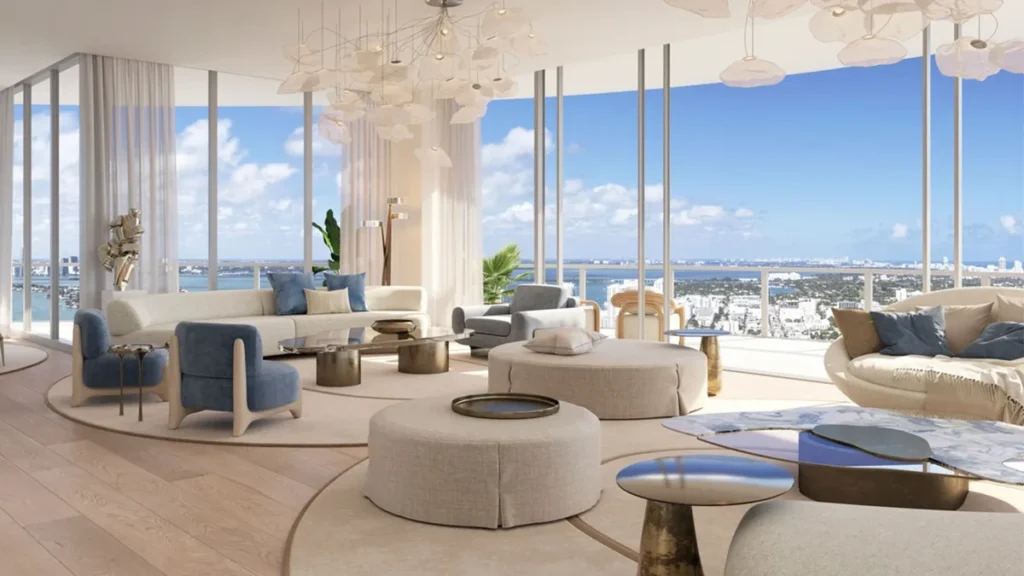
Cultural Shifts and the Art of Entertaining
Miami’s cultural ascent—fueled by international art fairs, yacht shows, and culinary festivals—has elevated the home as a venue for curated experiences. Owners frequently display museum-caliber art collections, host private chefs, and convene cross-continental networks.
Within this context, open-plan luxury living rooms provide the spatial theatre necessary for cultural exchange. The scale supports large-format artworks, bespoke seating ensembles, and fluid circulation during gatherings.
This phenomenon reinforces why Miami waterfront condos increasingly dedicate prime square footage to living and entertaining rather than compartmentalized formality.
Sustainability and Spatial Efficiency
Interestingly, larger living rooms can align with sustainability goals. By consolidating functions into one generous, well-lit area, designers reduce redundant walls and mechanical zoning. Enhanced daylight penetration lowers artificial lighting demands.
Forward-thinking Miami real estate trends integrate high-performance glazing, cross-ventilation strategies, and smart climate systems that ensure expansive interiors remain energy-efficient.
Thus, contemporary luxury condo interior design in Miami waterfront condos balances grandeur with environmental responsibility.
The Future Outlook for Waterfront Residences
Looking ahead, the trajectory is clear: spatial generosity will continue defining high-end development. As Miami strengthens its status as a global financial and cultural capital, buyer expectations will rise accordingly.
We can anticipate:
- Even wider structural bays enabling uninterrupted living areas.
- Movable partition systems for adaptable zoning.
- Integrated smart-glass technologies that modulate light and privacy.
- Greater emphasis on artisanal finishes and collectible design within expansive settings.
In this next chapter, open-plan luxury living rooms will not merely be large—they will be curated environments that express identity, heritage, and global perspective.
Scale as a Signature of Modern Miami
The enlargement of living areas in Miami waterfront condos represents more than a passing preference. It encapsulates evolving Miami real estate trends, cultural sophistication, and the demand for immersive spatial experiences.
For architects and developers, it signals a recalibration of proportion. For interior designers, it invites innovative approaches to luxury condo interior design that harmonize scale with intimacy. For discerning buyers, it offers a canvas upon which lifestyle, art, and ocean converge.
Ultimately, the expansive living room has become Miami’s architectural signature—a luminous stage set between sky and sea, where contemporary luxury finds its most compelling expression.