

In the evolving language of contemporary interiors, few materials have achieved the cultural resonance and professional admiration of bouclé. Once associated with mid-century modernism and discreet European salons, bouclé has re-emerged as a defining element of today’s most sophisticated spaces. Interior designers across the globe increasingly turn to bouclé furniture not merely for its visual appeal, but for its ability to articulate comfort, tactility, and modern aesthetics in a single, elegant gesture.
This renewed enthusiasm is not a passing trend. Rather, it reflects a broader shift in bouclé interior design toward spaces that prioritize sensory experience, emotional well-being, and material authenticity. As architects, designers, and discerning homeowners seek interiors that feel both elevated and inviting, bouclé upholstery has become a material of choice—quietly luxurious, visually soft, and inherently contemporary.
The Material Language of Bouclé
What Defines Bouclé?
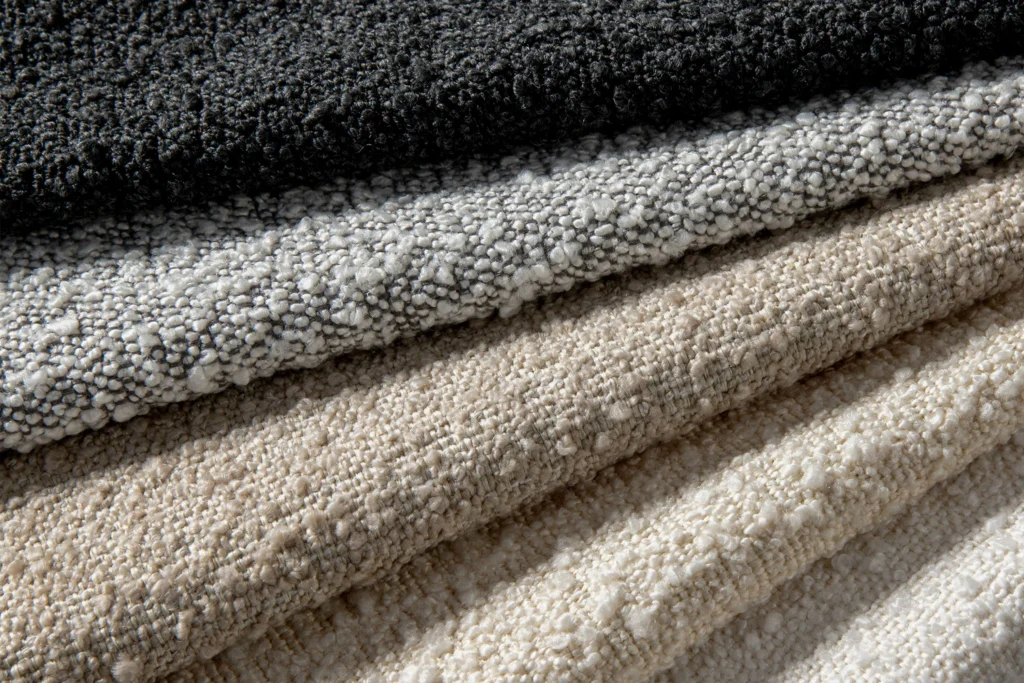
The term “bouclé,” derived from the French word for “looped,” refers to a textile characterized by its curled or knotted yarns. This looping creates a richly textured surface that absorbs light rather than reflecting it, resulting in a soft, matte appearance that feels organic and refined.
In bouclé upholstery, this texture becomes architectural. It adds dimension to furniture silhouettes without relying on ornamentation, making it particularly appealing to designers working within minimalist, modernist, or softly sculptural vocabularies.
A Heritage Rooted in Modernism
Bouclé’s current prominence is deeply connected to its historical lineage. The fabric was famously embraced by modernist designers of the mid-20th century, who sought materials that complemented new, expressive furniture forms. Its ability to soften bold lines and curved volumes made it ideal for sculptural seating and enveloping lounge pieces.
Today’s designers reference this heritage not as nostalgia, but as continuity—reinterpreting bouclé through contemporary proportions, advanced weaving techniques, and a refined palette suited to modern living.
Why Designers Are Drawn to Bouclé
Texture as a Design Tool
Texture has become a primary design language in contemporary interiors, particularly in neutral and monochromatic spaces. Bouclé offers a nuanced way to introduce depth without visual clutter.
- It creates contrast in minimalist environments dominated by stone, wood, or metal.
- It softens architectural rigidity, especially in large-scale residential or hospitality projects.
- It enhances visual interest without relying on color or pattern.
For interior designers, bouclé interior design provides a tactile counterpoint to hard surfaces, allowing spaces to feel layered, considered, and human-centric.
Comfort Beyond the Visual
While bouclé is visually compelling, its appeal extends far beyond aesthetics. The fabric’s plush, irregular surface offers a sense of physical comfort that is immediately perceptible. Seating upholstered in bouclé invites touch and encourages relaxation—qualities increasingly valued in both residential and commercial environments.
In an era where interiors are expected to support well-being, bouclé furniture aligns seamlessly with biophilic and wellness-oriented design philosophies. Its softness suggests refuge, making it particularly effective in lounges, private residences, and intimate hospitality settings.
Bouclé and Contemporary Aesthetics
Minimalism with Warmth
Modern minimalism has evolved. Where once it emphasized austerity and restraint, today it seeks warmth, tactility, and emotional resonance. Bouclé plays a critical role in this evolution.
In pared-back interiors, bouclé upholstery introduces softness without compromising clarity. Its subtle texture enriches neutral palettes—ivory, sand, taupe, or soft grey—allowing designers to maintain visual calm while avoiding sterility.
Sculptural Forms and Bouclé Furniture
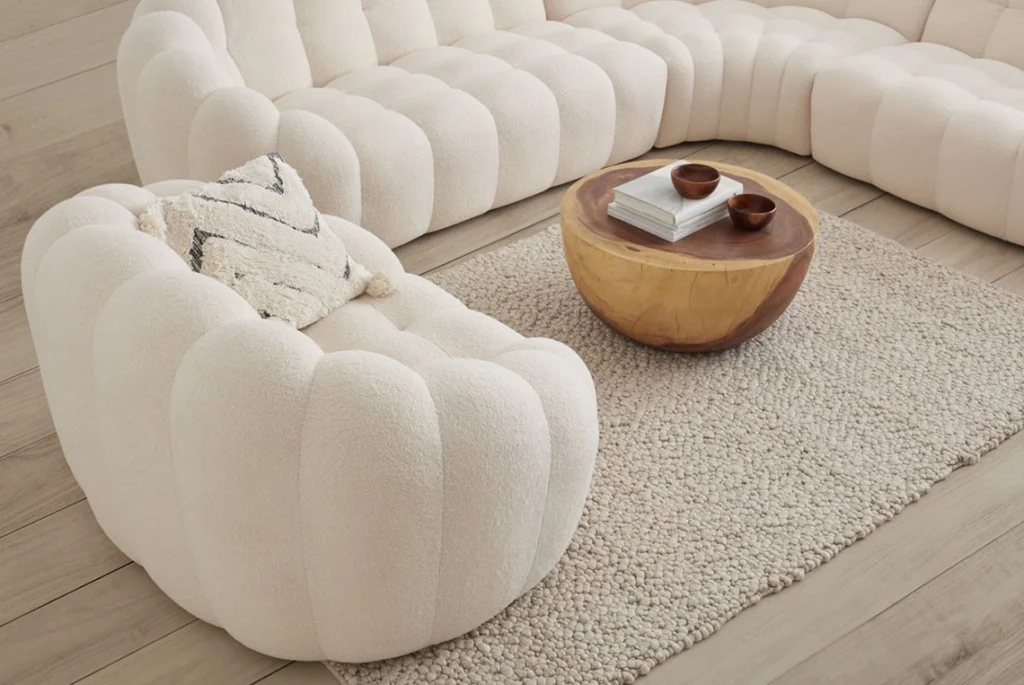
One of the most compelling reasons designers favor bouclé is its synergy with sculptural furniture forms. Curved sofas, rounded armchairs, and organic silhouettes are enhanced by the fabric’s ability to emphasize volume and contour.
Unlike flat weaves or glossy materials, bouclé absorbs shadows and highlights, accentuating form rather than surface. This makes it particularly effective for statement pieces that function as both furniture and functional art.
Versatility Across Design Contexts
Residential Interiors
In private residences, bouclé furniture conveys understated luxury. It signals refinement without ostentation, appealing to homeowners who value discretion and material quality over overt display.
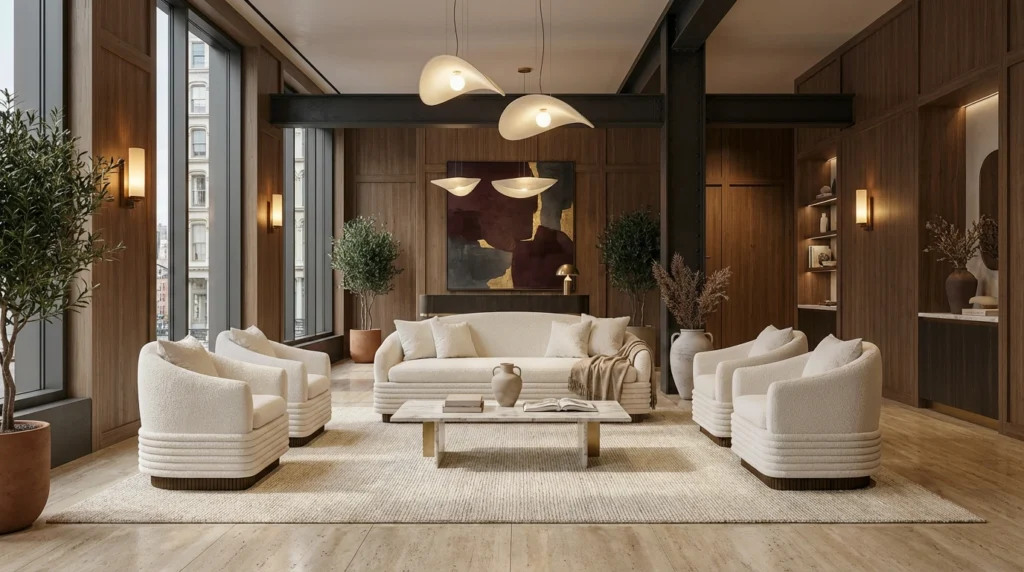
Designers frequently incorporate bouclé upholstery in living rooms, bedrooms, and reading nooks—spaces intended for rest and retreat. Its neutral elegance allows it to coexist effortlessly with diverse materials, from marble and travertine to dark timber and brushed brass.
Hospitality and Luxury Real Estate
Bouclé has also become a staple in high-end hospitality and luxury real estate projects. In hotel lobbies, boutique suites, and show residences, the fabric communicates comfort and exclusivity simultaneously.
For developers and real estate professionals, bouclé interior design offers a strategic advantage: it photographs beautifully, ages gracefully, and resonates with an international clientele attuned to contemporary design narratives.
Durability and Performance Considerations
Modern Bouclé Upholstery Innovations
One lingering misconception about bouclé concerns durability. While traditional bouclé was often reserved for low-traffic areas, contemporary manufacturing has significantly expanded its performance capabilities.
Today’s bouclé upholstery is frequently engineered with enhanced resilience, stain resistance, and colorfastness, making it suitable for everyday use in both residential and commercial contexts.
Longevity as a Sustainability Asset
Longevity is increasingly central to responsible design. Bouclé’s timeless aesthetic and tactile appeal encourage long-term ownership, aligning with sustainable principles that prioritize quality over disposability.
Bouclé in Global Design Culture
A Universal Appeal
From Parisian apartments to New York penthouses and Mediterranean villas, bouclé furniture transcends regional design codes. Its appeal lies in its adaptability: it feels equally at home in European modernism, Californian minimalism, and contemporary Asian interiors.
This universality makes bouclé a powerful tool for international designers working across markets and cultures, offering a shared material language that resonates globally.
A Symbol of Quiet Luxury
As the concept of luxury evolves, bouclé has emerged as a symbol of restraint and discernment. It aligns with a shift away from overt branding toward materials that communicate value through texture, craftsmanship, and subtlety.
For high-net-worth individuals and design professionals alike, bouclé upholstery represents an investment in comfort, culture, and timeless aesthetics rather than fleeting visual statements.
The Future of Bouclé in Interior Design
Beyond the Trend Cycle
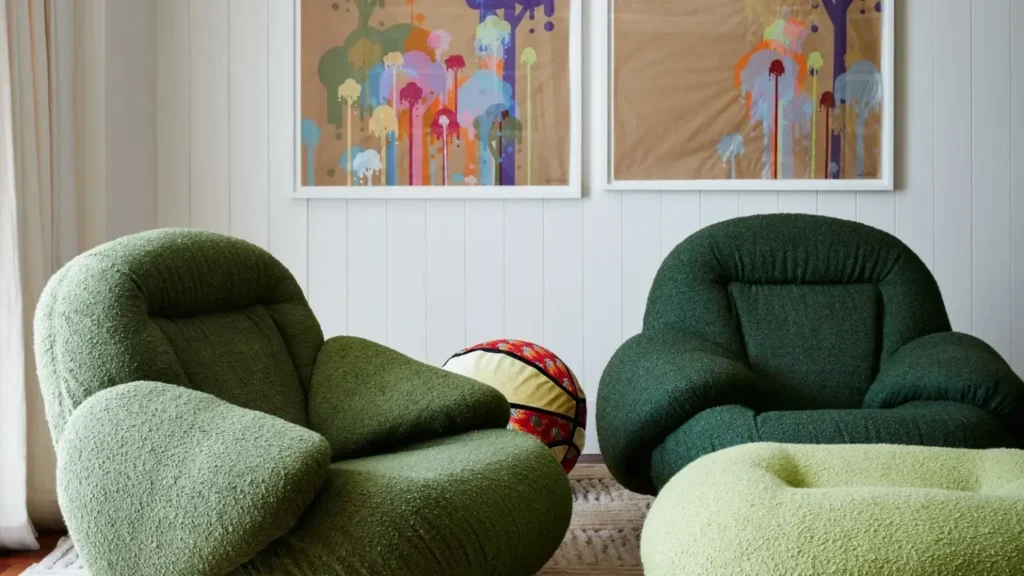
While bouclé’s popularity is undeniable, its sustained relevance suggests something deeper than trend adoption. Designers increasingly view bouclé furniture as a foundational element—one that can evolve with changing interiors rather than date them.
Its ability to adapt to new forms, colors, and contexts ensures that bouclé will continue to play a meaningful role in contemporary design discourse.
Materiality as Experience
Ultimately, the enduring love for bouclé reflects a broader shift in how interiors are conceived. Spaces are no longer designed solely to be seen; they are designed to be felt.
In this sensory-driven paradigm, bouclé interior design stands out as a material expression of comfort, modernity, and emotional intelligence—qualities that define the most compelling interiors of today and tomorrow.
The Takeaway
Interior designers’ enduring affection for bouclé is rooted in more than visual appeal. Through its texture, comfort, and modern aesthetic sensibility, bouclé furniture bridges the gap between form and feeling. It enriches spaces without overwhelming them, offering a refined response to contemporary desires for warmth, authenticity, and quiet sophistication.
As design continues to evolve toward more human-centric environments, bouclé upholstery remains a material that speaks fluently to both the eye and the senses—making it not just a favorite of today, but a classic of the future.