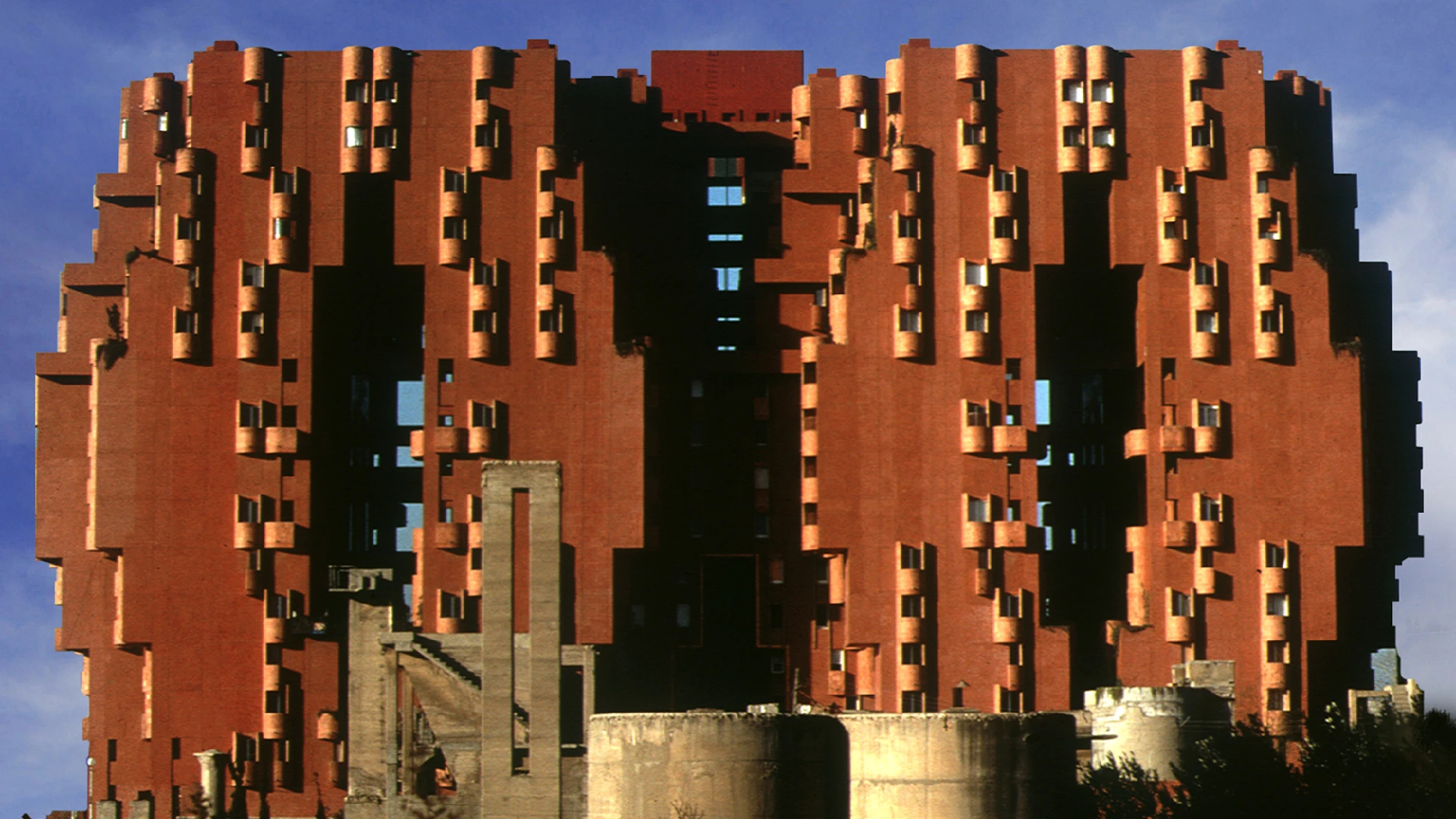
Few residential complexes have challenged architectural conventions as boldly as Walden 7. Rising like a surreal fortress of terracotta towers outside Barcelona, the monumental structure represents one of the most visionary experiments in postmodern residential architecture. Designed by the acclaimed Catalan architect Ricardo Bofill and completed in 1975, the project remains a radical reinterpretation of collective housing—an urban labyrinth where geometry, color, and community converge.
Nearly five decades after its completion, Walden 7 continues to captivate architects, designers, and cultural observers worldwide. Its sculptural silhouette and vibrant interiors embody a daring architectural philosophy that sought to reimagine the relationship between private living and communal experience. Today, the building stands as both a historic landmark and a living residential ecosystem, illustrating how visionary design can transform the way people inhabit space.
The Vision of Ricardo Bofill
Behind the striking geometry of Walden 7 lies the experimental spirit of Ricardo Bofill, founder of the renowned multidisciplinary practice Ricardo Bofill Taller de Arquitectura (RBTA). During the late 1960s and early 1970s, Bofill and his team began exploring new models of collective living that would challenge the monotony of modernist housing blocks.
The goal was ambitious: to design a vertical city that would foster interaction, diversity, and spatial richness. Inspired by utopian urban theories and Mediterranean village typologies, Bofill envisioned a complex where residents would move through interconnected courtyards, bridges, terraces, and staircases—creating a spatial narrative that encouraged exploration.
Rather than prioritizing uniformity, Ricardo Bofill embraced complexity. The result was a residential labyrinth composed of stacked modular units, forming a three-dimensional puzzle that offers unexpected vistas and communal encounters.
A Radical Approach to Postmodern Residential Architecture
In the broader context of postmodern residential architecture, Walden 7 represents a decisive break from the rigid functionalism of mid-century modernism. Instead of repeating identical façades and corridors, Bofill introduced spatial drama and symbolic expression.
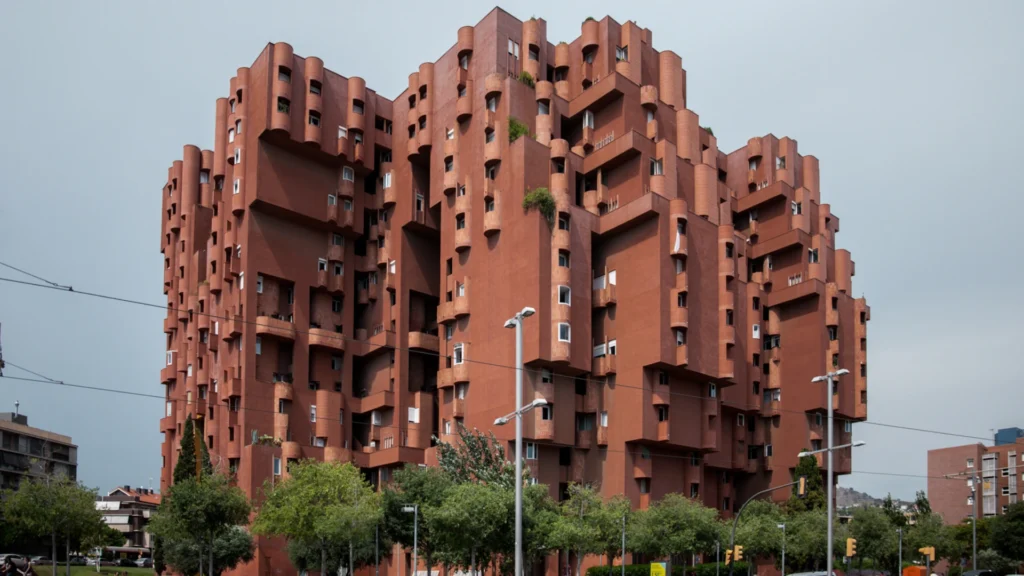
The building’s design consists of eighteen towers connected around five interior courtyards. From afar, the structure resembles a monumental fortress. Yet within, the environment reveals a surprisingly intimate scale, where bridges and balconies create a dynamic network of circulation.
- Terracotta façades that evoke Mediterranean earth tones
- Vertical courtyards that bring light and air deep into the structure
- Interlocking apartments arranged in modular clusters
- Sky bridges and terraces fostering shared social spaces
Through these elements, Walden 7 transformed collective housing into a spatial experience—one that merges architecture, sculpture, and urbanism.
The Spatial Labyrinth of Walden 7
To walk through Walden 7 is to enter a carefully choreographed architectural maze. Corridors open onto soaring atriums, while narrow bridges reveal dramatic views across the building’s colorful interior courtyards.
The structure contains more than 440 apartments, yet its organization avoids the anonymity often associated with large residential complexes. Instead, Ricardo Bofill designed the building as a series of interconnected neighborhoods stacked vertically.
Modular Living Units
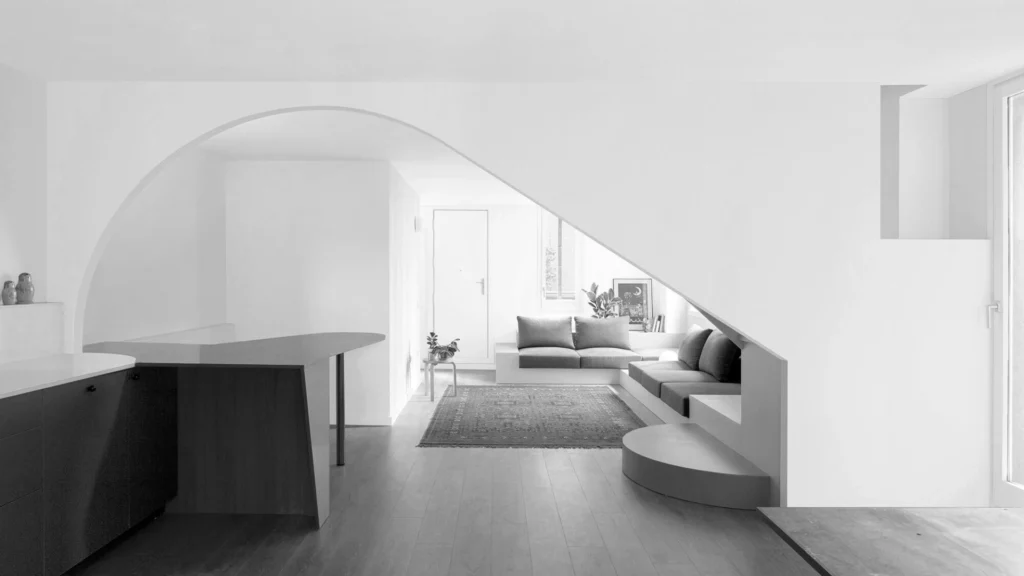
The apartments themselves are based on a modular system composed of square units. Individual homes combine one to four modules, allowing for varied configurations that accommodate different lifestyles.
This flexible system supports:
- Compact studio residences
- Duplex apartments with double-height spaces
- Family-sized homes with multiple modules
- Terraced apartments with private outdoor areas
By breaking away from standardized floor plans, Walden 7 introduced a level of architectural individuality rarely found in large-scale housing developments.
The Dramatic Interior Courtyards
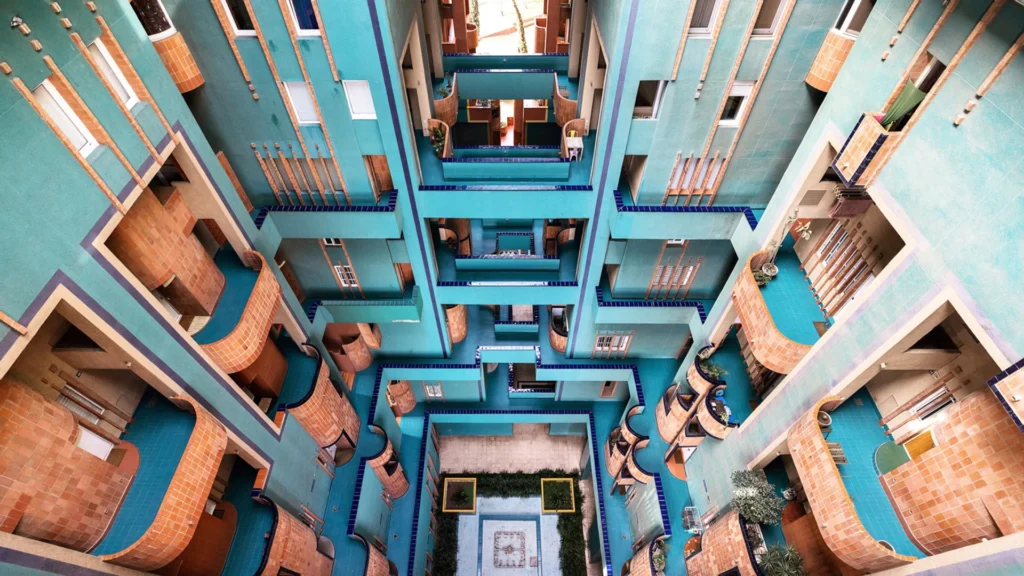
Perhaps the most visually striking feature of Walden 7 lies within its five towering courtyards. Painted in shades of cobalt blue, turquoise, and terracotta, these vertical voids create a theatrical spatial experience.
Sunlight filters through the open roof structures, casting shifting patterns of color across the façades and walkways. The effect is both monumental and intimate—a spatial interplay that reinforces the building’s identity as a landmark of postmodern residential architecture.
The courtyards also perform a practical function, ensuring natural ventilation and daylight reach the building’s interior apartments. This fusion of aesthetic drama and environmental performance remains one of Ricardo Bofill’s most enduring architectural achievements.
Influence and Cultural Legacy
Over time, Walden 7 has evolved into a global icon. Its surreal geometry and vivid colors have inspired countless photographers, filmmakers, and designers.
In recent years, the building has experienced a renewed wave of international attention. Social media and architectural publications have reintroduced Walden 7 to a new generation fascinated by visionary residential design.
The complex is frequently cited in discussions about the future of urban housing. Its emphasis on communal space and spatial diversity resonates strongly with contemporary architectural debates surrounding density, community, and livability.
For further insight into Ricardo Bofill and his architectural philosophy, the ArchDaily architecture platform provides extensive documentation of his influential work.
Postmodern Architecture Reconsidered
When Walden 7 was first completed, reactions were mixed. Some critics saw the project as overly theatrical, while others celebrated its bold challenge to architectural orthodoxy.
Today, however, the building is widely regarded as one of the most successful examples of postmodern residential architecture. Its ability to balance experimental form with functional living has allowed it to remain vibrant decades after its construction.
Several qualities contribute to its enduring relevance:
- Architectural identity that transcends conventional housing blocks
- Flexible modular apartments adaptable to changing lifestyles
- Generous communal spaces encouraging social interaction
- A visually powerful architectural language
These attributes demonstrate how Ricardo Bofill anticipated many of the design priorities shaping contemporary urban living.
Life Inside Walden 7 Today
Unlike many experimental housing projects of the 20th century, Walden 7 remains an active and thriving residential community. Renovations in the 1990s restored the building’s original terracotta façade and improved infrastructure while preserving the architect’s vision.
Today, residents describe the experience of living inside Walden 7 as uniquely immersive. The building’s vertical streets and communal terraces encourage spontaneous interaction, creating a sense of neighborhood rarely found in modern apartment towers.
At the rooftop level, shared swimming pools and terraces offer sweeping views across the Barcelona metropolitan landscape. These elevated social spaces reinforce the building’s original ambition: to create a micro-city where architecture fosters connection.
The Architectural Lessons of Walden 7
The lasting relevance of Walden 7 lies not only in its dramatic appearance but in the ideas it represents. In an era when cities worldwide are confronting housing shortages and increasing density, the project offers valuable insights.
Designing Community in Vertical Housing
One of the central challenges of contemporary urban development is maintaining social cohesion within high-density environments. Ricardo Bofill addressed this issue decades ago through the spatial choreography of Walden 7.
The building’s bridges, terraces, and courtyards transform circulation routes into places of encounter. Rather than isolating residents behind anonymous corridors, the architecture encourages visual connection and shared experiences.
The Power of Architectural Identity
Another lesson from Walden 7 is the importance of character in residential design. Too often, large housing developments prioritize efficiency at the expense of identity.
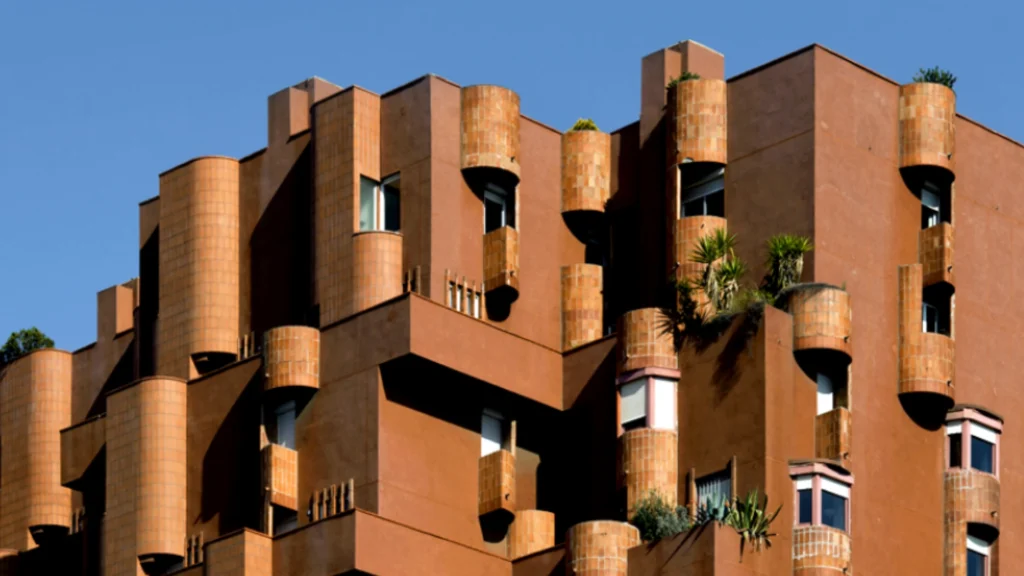
By contrast, postmodern residential architecture embraces symbolism, color, and narrative. In the case of Walden 7, these elements contribute to a strong sense of belonging among residents and a powerful cultural presence within the city.
Walden 7 as a Timeless Postmodern Icon
Nearly half a century after its completion, Walden 7 remains one of the most visionary housing projects ever built. Its monumental geometry, vibrant courtyards, and layered spatial experience continue to inspire architects and designers around the world.
The project represents a defining moment in the career of Ricardo Bofill and a landmark achievement in postmodern residential architecture. More than a building, it is a living experiment in how architecture can shape community, identity, and urban life.
As cities continue to evolve and housing demands grow more complex, the lessons of Walden 7 feel more relevant than ever. It stands as a reminder that residential architecture can be bold, imaginative, and profoundly human—transforming everyday living into a rich architectural experience.