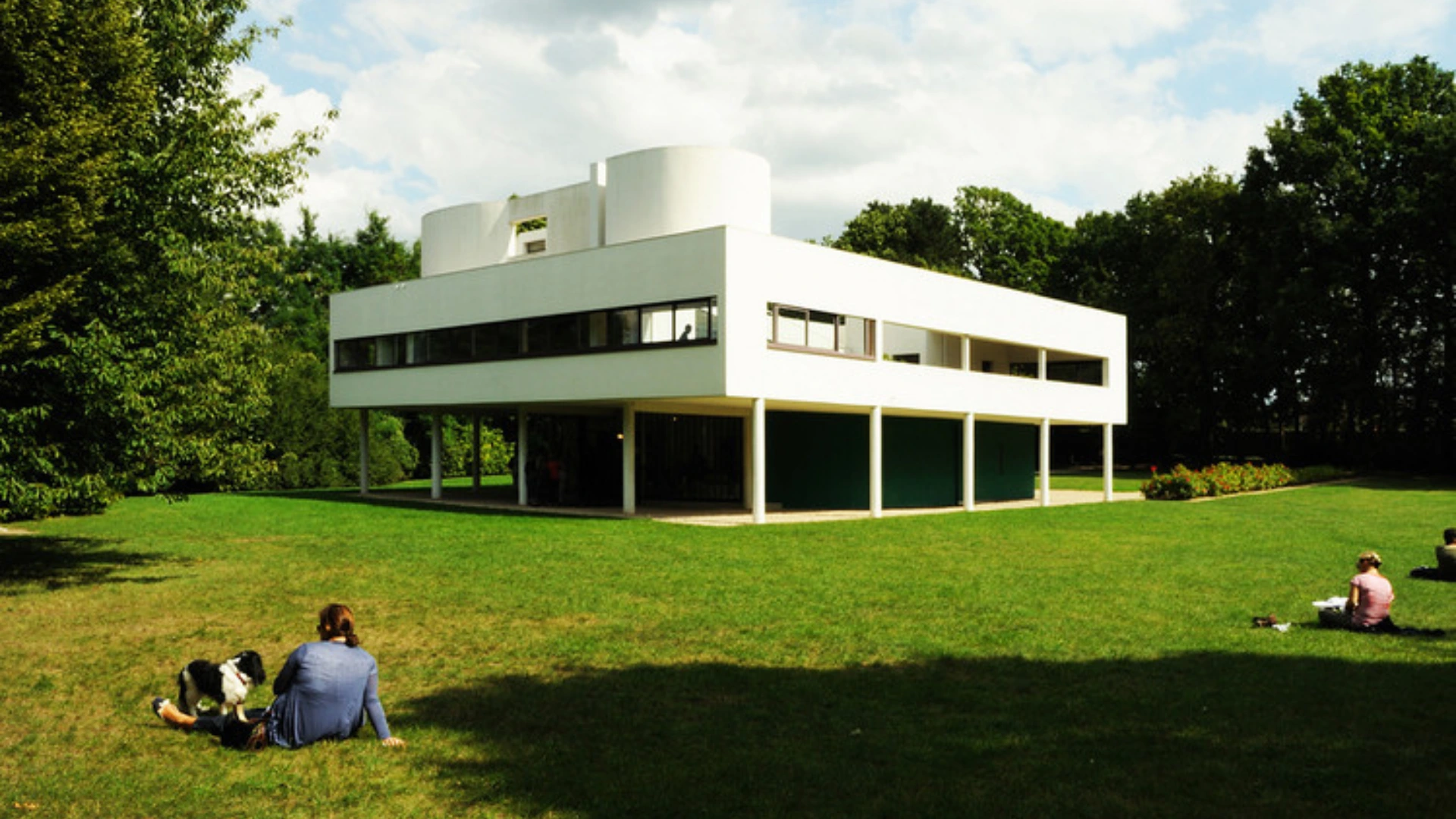

Few residences have shaped the course of modernist architecture as profoundly as Villa Savoye. Designed by the visionary Swiss-French architect Le Corbusier and completed in 1931 in Poissy, just outside Paris, the house stands as one of the most celebrated icons of twentieth-century design. More than a private residence, Villa Savoye became a manifesto—an architectural statement that distilled the principles of modern living into a built form that continues to inspire architects, designers, and cultural thinkers worldwide.
Today, Villa Savoye is regarded as a defining example of both modernist architecture and modernist interior design, embodying the radical ideas that reshaped the built environment during the early modernist movement. Its clean geometry, floating volumes, and integration with the surrounding landscape illustrate how architecture could break away from historical ornamentation to embrace function, technology, and a new vision of lifestyle.
Nearly a century after its completion, the residence remains a pilgrimage site for design professionals and cultural enthusiasts seeking to understand the intellectual and aesthetic foundations of modern architecture.
The Vision Behind Villa Savoye
Commissioned by Pierre and Eugénie Savoye as a country retreat, Villa Savoye was conceived during a transformative moment in architectural history. By the late 1920s, Le Corbusier had already articulated his revolutionary theory known as the “Five Points of Architecture.” These principles would find their most refined expression in this remarkable house.
The residence was not simply a villa—it was an experiment in spatial freedom, light, and technological optimism. The Savoye family provided Le Corbusier with an opportunity to translate theoretical ideas into a complete architectural composition.
Le Corbusier’s Five Points of Architecture
The design of Villa Savoye embodies the five principles that redefined modernist architecture in the twentieth century:
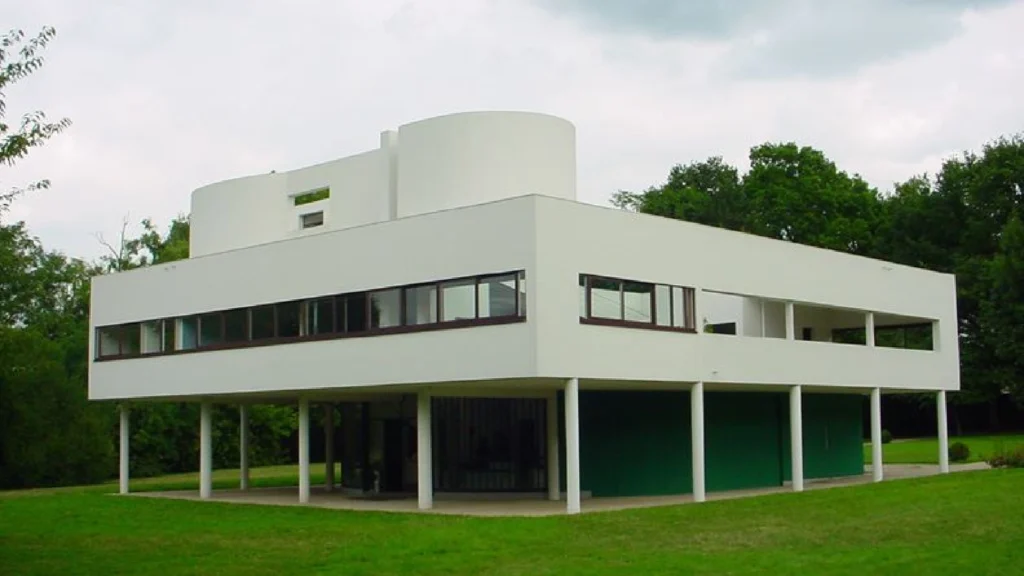
- Pilotis – Reinforced concrete columns lift the structure off the ground, creating an open landscape beneath the house.
- Free floor plan – Structural independence allows flexible interior layouts.
- Free façade – Exterior walls are no longer structural, enabling creative façade compositions.
- Ribbon windows – Long horizontal windows maximize daylight and panoramic views.
- Roof garden – A flat roof becomes a functional outdoor space reconnecting architecture with nature.
At Villa Savoye, these five points work together seamlessly, forming a building that appears to float above the landscape while maintaining an extraordinary clarity of form.
Architectural Composition: A Machine for Living
Le Corbusier famously described the modern home as a “machine for living.” In Villa Savoye, this concept is expressed through precise geometry, industrial materials, and an emphasis on efficiency. The structure’s rectangular volume is elevated on slender pilotis, creating a striking visual contrast between the solid white mass and the open ground plane beneath.
Approaching the house, visitors encounter a carefully choreographed sequence of movement. A curved driveway guides automobiles beneath the building, reflecting the growing influence of the automobile on architectural planning in the early twentieth century.
The result is a residence that merges modern technology with spatial poetry—a hallmark of modernist architecture.
The Architectural Promenade
Central to the experience of Villa Savoye is what Le Corbusier called the architectural promenade. Rather than static rooms, the house is designed as a continuous spatial journey.
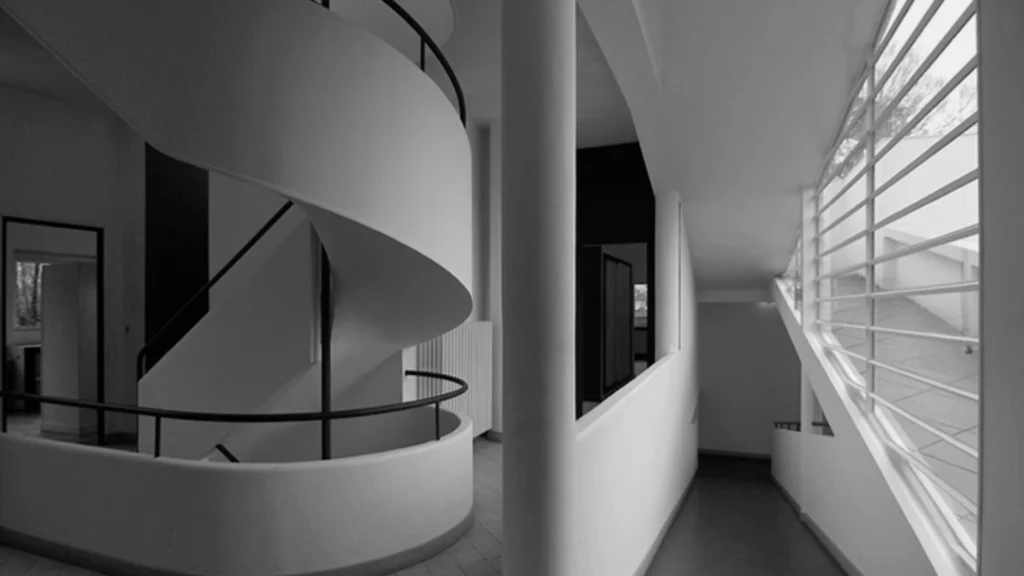
Visitors enter at ground level and gradually ascend through the structure via a gently sloping ramp and sculptural staircase. This orchestrated movement reveals the building step by step, culminating in the open rooftop terrace where architecture and landscape merge.
The promenade reinforces the conceptual clarity of modernist architecture, transforming circulation into an essential design element rather than a mere functional necessity.
Modernist Interior Design at Villa Savoye
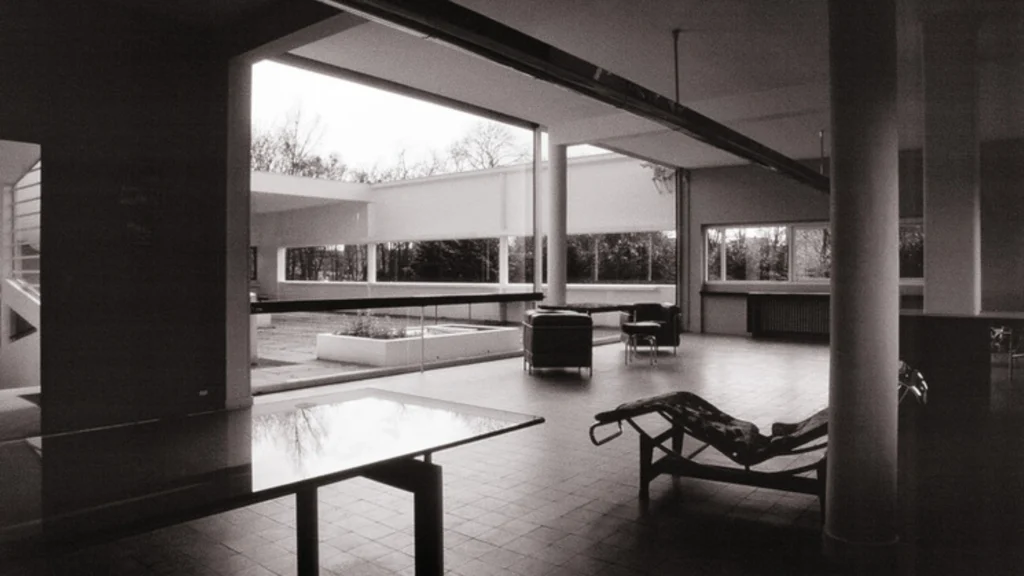
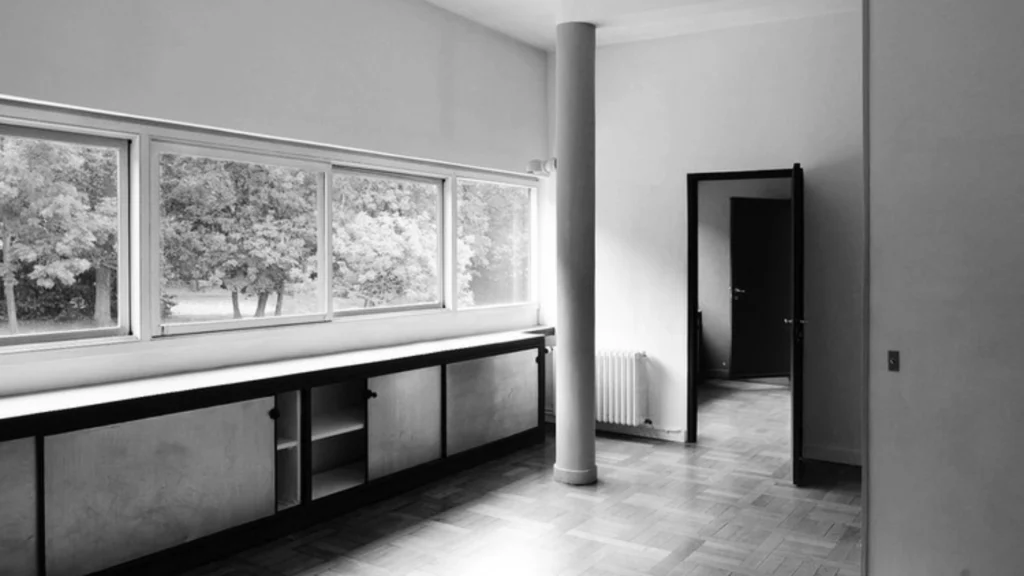
While the exterior of Villa Savoye is often celebrated as an icon of modernist architecture, the interior spaces are equally significant. The house demonstrates how modernist interior design can achieve harmony through minimalism, proportion, and light.
Unlike traditional interiors defined by heavy ornamentation, the rooms within Villa Savoye emphasize clarity and openness. Walls are smooth and white, surfaces are restrained, and the spatial layout prioritizes flexibility and movement.
Key Characteristics of the Interior
- Open spatial planning that dissolves rigid boundaries between rooms.
- Continuous ribbon windows providing natural light and landscape views.
- Curved interior walls that soften the geometry of the structure.
- Integrated built-in furnishings aligned with the principles of modernist interior design.
- Color accents strategically applied to guide spatial perception.
These elements illustrate how modernist interior design prioritizes human experience while maintaining aesthetic restraint. At Villa Savoye, every detail—from the placement of windows to the flow of circulation—serves a broader architectural concept.
The Rooftop Garden: Nature Reimagined
One of the most innovative features of Villa Savoye is its rooftop terrace. At a time when flat roofs were rarely used as functional spaces, Le Corbusier envisioned the roof as a new landscape—an elevated garden that reconnects residents with nature.
This concept reflects a core ambition of modernist architecture: to reconcile industrial construction methods with the human need for natural surroundings.
The rooftop terrace includes sculptural walls, curved forms, and open views of the surrounding countryside. Here, the geometric purity of the building meets the organic rhythm of the landscape, creating a contemplative environment that remains remarkably contemporary today.
Challenges and Restoration
Despite its architectural significance, Villa Savoye faced numerous challenges in its early years. Construction issues, water infiltration, and the financial difficulties of the Savoye family complicated the house’s history. During World War II, the property suffered damage and neglect.
By the 1950s, the future of Villa Savoye was uncertain. Plans even emerged to demolish the building. However, the growing recognition of its cultural value prompted preservation efforts.
In 1965, the French government declared Villa Savoye a historic monument—an extraordinary distinction granted during Le Corbusier’s lifetime. Extensive restoration work eventually returned the residence to its original condition, allowing visitors to experience one of the most influential examples of modernist architecture.
Today, the house is maintained by the French state and welcomes thousands of visitors each year.
Villa Savoye’s Lasting Influence
The impact of Villa Savoye extends far beyond its physical site in Poissy. The house fundamentally transformed architectural thinking and continues to shape contemporary design discourse.
Influence on Modern Architecture
- It established a universal vocabulary for modernist architecture.
- It demonstrated how technology could redefine domestic space.
- It inspired generations of architects exploring minimalism and spatial freedom.
- It advanced the integration of landscape within architectural design.
Many of today’s most celebrated architects—from Richard Meier to Tadao Ando—have acknowledged the profound influence of Le Corbusier’s work, particularly the lessons embedded within Villa Savoye.
Villa Savoye in Contemporary Design Culture
Nearly one hundred years after its completion, Villa Savoye remains a powerful reference point in discussions of modernist interior design and modernist architecture. Its enduring relevance lies in the clarity of its ideas: architecture as an expression of lifestyle, technology, and cultural transformation.
In contemporary luxury residences and minimalist interiors around the world, echoes of Villa Savoye can still be found—from open floor plans to expansive glazing and rooftop terraces. Designers continue to reinterpret these principles in ways that respond to modern sustainability goals and evolving lifestyles.
For professionals across architecture, real estate, and design, the house represents a timeless benchmark for conceptual rigor and spatial elegance.
Visiting Villa Savoye Today
Located in Poissy, approximately 30 kilometers from Paris, Villa Savoye is open to the public and managed by France’s Centre des Monuments Nationaux. Visitors can explore the house, the rooftop garden, and the surrounding landscape that originally inspired its design.
Experiencing the building in person reveals subtleties that photographs cannot capture—the gentle slope of the ramp, the changing light along the ribbon windows, and the serene atmosphere of the rooftop terrace.
For architects and design enthusiasts, a visit to Villa Savoye offers an invaluable opportunity to understand the spatial philosophy that reshaped twentieth-century architecture.
The Takeaway
More than a historic residence, Villa Savoye stands as a defining symbol of architectural modernism. Through its revolutionary spatial planning, disciplined geometry, and pioneering approach to modernist interior design, the house encapsulates a moment when architecture boldly reimagined how people could live.
Its influence continues to resonate across global design culture, reminding us that truly visionary architecture transcends time. As both a cultural landmark and a living lesson in modernist architecture, Villa Savoye remains one of the most important homes ever built.
For further architectural context, see the documentation provided by the Fondation Le Corbusier, which preserves and studies the legacy of the architect and his groundbreaking works.