

In the most accomplished interiors, storage is not an afterthought — it is an architectural strategy. Today’s most refined residences, from Manhattan penthouses to Mediterranean villas, share a defining characteristic: function is present, but never visible. The art of hidden storage solutions has evolved into a discipline where craftsmanship, engineering, and spatial intelligence converge. For architects, interior designers, and discerning homeowners, the challenge is no longer how much to store, but how seamlessly storage can dissolve into the architecture itself.
In high-end interiors, clutter is considered a design failure. True luxury lies in clarity, flow, and proportion. The rise of concealed storage furniture and sophisticated built-in cabinetry design reflects a broader shift toward interiors that feel effortless, curated, and serene. This article explores how luxury interior storage is redefining spatial experience — and why storage that doesn’t look like storage has become the new hallmark of refined living.
The Philosophy Behind Invisible Function
Minimalism may have introduced the aesthetic of visual restraint, but contemporary high-end interiors go far beyond minimalism. The objective is not emptiness — it is orchestration. Hidden storage solutions allow designers to maintain architectural purity while accommodating the complexities of modern life.
From integrated wall systems to millwork that disappears into shadow lines, concealed storage furniture protects the integrity of the space. Surfaces remain uninterrupted. Volumes read as intentional. The eye moves freely.
This philosophy echoes principles long championed in modern architecture, including those articulated by ArchDaily, where spatial clarity and material continuity are often emphasized as foundations of contemporary design.
Why High-End Clients Demand Concealed Storage
- Visual tranquility: Eliminates distraction and promotes calm.
- Architectural cohesion: Maintains uninterrupted lines and planes.
- Spatial optimization: Maximizes usable square footage discreetly.
- Security and privacy: Protects valuables without overt safes or cabinets.
- Long-term value: Integrated luxury interior storage increases property appeal.
Built-In Cabinetry Design as Architecture
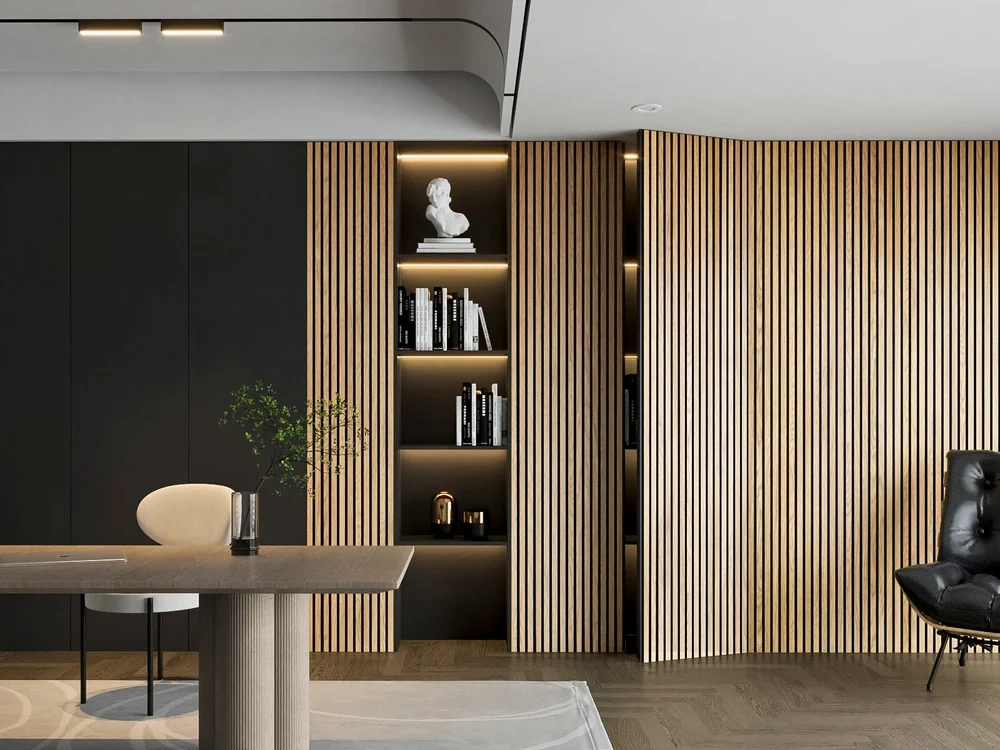
At the highest level, built-in cabinetry design is not furniture; it is architecture. It is conceived alongside structural elements, lighting plans, and circulation paths. In bespoke residences, cabinetry is often flush-mounted, handleless, and finished in materials that echo walls — lacquer, wood veneer, microcement, or stone.
The result is storage that reads as wall paneling or sculptural relief rather than functional containment. Advanced hidden storage solutions frequently incorporate:
- Push-latch systems with no visible hardware
- Shadow-gap detailing for seamless transitions
- Integrated LED lighting concealed within recesses
- Full-height pivot doors that blend with wall planes
- Acoustic panel systems doubling as storage fronts
When executed properly, luxury interior storage becomes indistinguishable from architectural composition.
The Kitchen: A Masterclass in Concealment
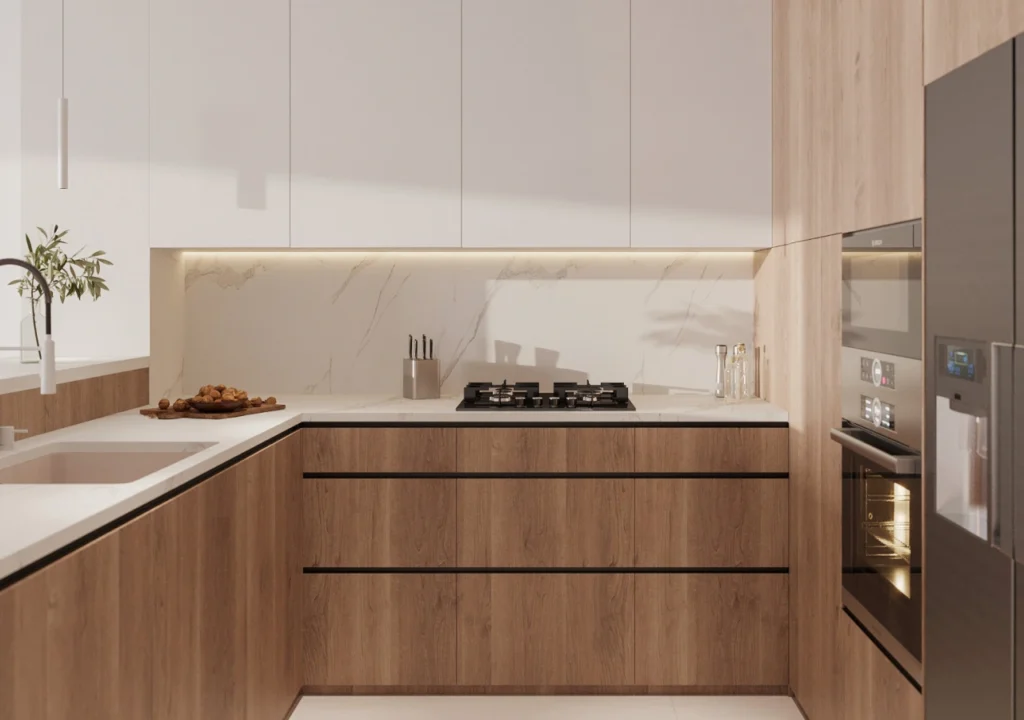
The contemporary luxury kitchen has become a study in controlled invisibility. Appliances disappear behind paneled fronts. Pantries retract behind pocket doors. Entire preparation zones vanish when entertaining begins.
Designers increasingly rely on concealed storage furniture systems that allow kitchens to transition between functional workspace and social salon. This duality is particularly valued in open-plan residences, where sightlines extend across living and dining areas.
Here, hidden storage solutions are not merely aesthetic choices; they preserve spatial harmony.
Furniture That Conceals More Than It Reveals
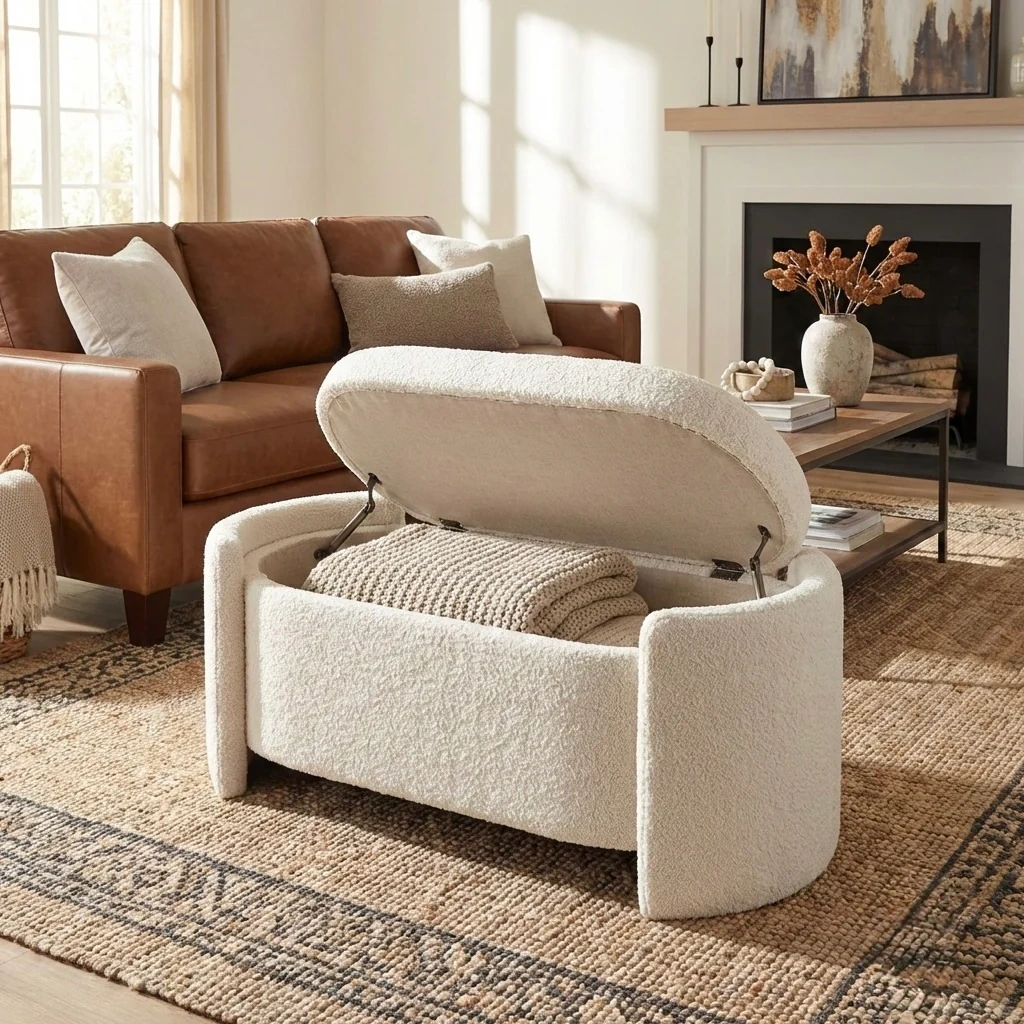
While built-ins provide architectural permanence, freestanding pieces also play a pivotal role. The new generation of concealed storage furniture integrates compartments, lift-top mechanisms, and modular systems without compromising form.
Key Typologies in Concealed Storage Furniture
- Platform beds with integrated drawer systems
- Coffee tables with hydraulic lift tops
- Ottomans with hidden compartments
- Sideboards with secret inner drawers
- Wall-mounted consoles with sliding panels
What distinguishes high-end interpretations is not the mechanism itself, but the discretion of its integration. Materials remain tactile and luxurious — solid walnut, brushed brass, hand-finished lacquer — ensuring that luxury interior storage never feels utilitarian.
For brands operating at the intersection of craftsmanship and innovation, the goal is to design pieces where storage is intuitive yet invisible.
Spatial Psychology and the Luxury of Order
There is a psychological dimension to hidden storage solutions that transcends aesthetics. Neuroscientific studies increasingly link visual clutter to cognitive fatigue. By contrast, ordered environments enhance focus, well-being, and perceived spaciousness.
In ultra-prime real estate, particularly in global cities where square footage commands exceptional value, luxury interior storage directly influences both livability and resale potential. Buyers are drawn to residences that feel expansive — even when dimensions are finite.
How Concealed Storage Enhances Perceived Space
- Reduces visual noise and object density
- Allows architectural features to dominate
- Strengthens symmetry and proportion
- Improves light reflection across uninterrupted surfaces
Through intelligent built-in cabinetry design, designers effectively expand the experiential footprint of a room without altering its structural envelope.
The Role of Craftsmanship and Technology
Advanced hidden storage solutions depend on precision engineering. Soft-close mechanisms, motorized panels, biometric locking systems, and climate-controlled compartments are now common in elite residences.
Yet technology must remain silent. The ultimate expression of concealed storage furniture is one where innovation supports elegance rather than announcing itself.
Emerging Innovations in Luxury Interior Storage
- Motorized retractable wardrobes integrated into wall cavities
- Hidden charging stations within millwork
- Climate-regulated cabinetry for art and wine storage
- Rotating library walls concealing private offices
- Mirror panels masking walk-in closets
These innovations elevate luxury interior storage into a bespoke experience tailored to the owner’s lifestyle.
Materiality: The Invisible Language of Integration
Material selection determines whether built-in cabinetry design blends seamlessly or feels appended. Continuity of grain, texture alignment, and color matching are critical.
Stone-wrapped cabinets, fluted timber panels concealing wardrobes, and microcement finishes extending across doors and storage fronts exemplify how hidden storage solutions dissolve into architectural surfaces.
In many high-end projects, designers specify full-height panels with concealed reveals, allowing concealed storage furniture to read as sculptural wall treatments. The effect is immersive and cohesive.
Applications Across the Home
Living Areas
Integrated media walls exemplify contemporary luxury interior storage. Screens retract. Speakers hide within acoustic paneling. Cabinetry conceals devices and cables entirely.
Bedrooms
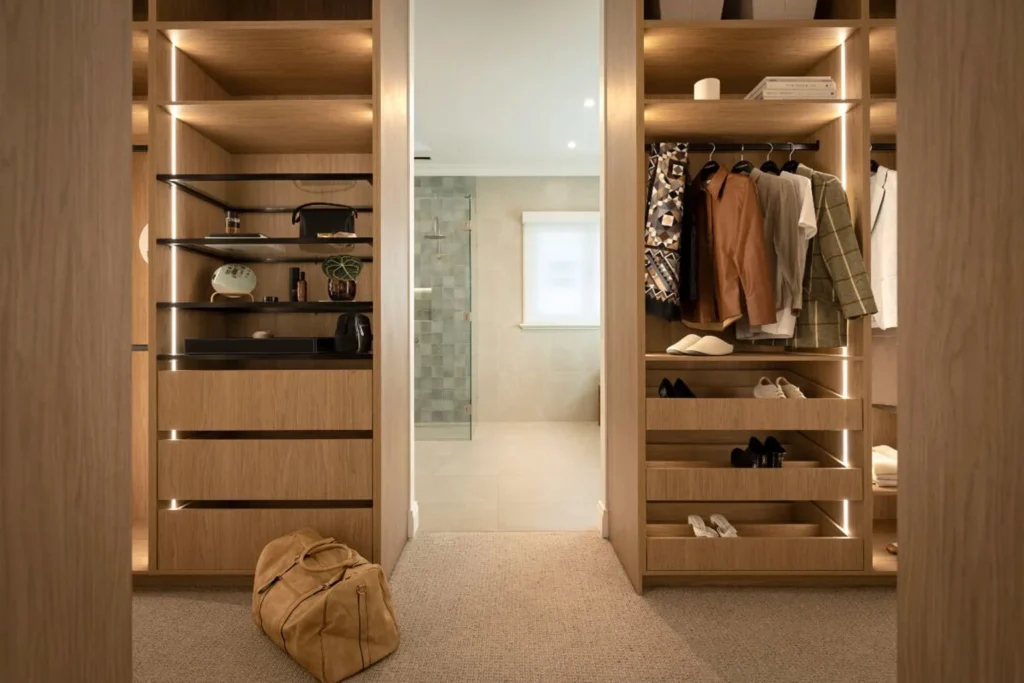
Custom wardrobes designed through thoughtful built-in cabinetry design eliminate freestanding closets, creating uninterrupted architectural envelopes.
Bathrooms
Recessed niches, mirrored cabinets with concealed shelving, and floating vanities with hidden compartments demonstrate how hidden storage solutions maintain spa-like calm.
Home Offices
In hybrid living environments, concealed storage furniture allows work zones to disappear at day’s end — preserving the domestic character of the home.
Design Principles for Achieving Invisible Storage
For architects and designers seeking to integrate luxury interior storage seamlessly, several principles guide successful outcomes:
- Plan storage at concept stage, not post-design.
- Align cabinetry proportions with architectural grids.
- Limit visible hardware.
- Use material continuity to disguise transitions.
- Incorporate lighting strategically to enhance depth.
When these principles inform built-in cabinetry design, storage becomes an intrinsic component of spatial narrative.
The Future of Concealed Function
As urban density increases and lifestyles evolve, hidden storage solutions will continue to define sophisticated interiors. The future lies in adaptive systems — modular yet elegant, technologically advanced yet discreet.
We are witnessing a paradigm in which concealed storage furniture is no longer a convenience but an expectation within luxury environments. In this context, luxury interior storage serves as both functional infrastructure and aesthetic philosophy.
The Takeaway
Storage that does not look like storage represents more than a design trend. It reflects a cultural shift toward intentional living, spatial clarity, and architectural integrity. Through refined built-in cabinetry design, meticulously engineered hidden storage solutions, and elegantly crafted concealed storage furniture, interiors achieve a rare balance: complexity concealed within simplicity.
For global design professionals and discerning homeowners alike, the message is clear. The most luxurious spaces are not those that display abundance, but those that curate it invisibly. In the quiet precision of luxury interior storage, contemporary elegance finds its most compelling expression.