

The Art of Intimacy in a Vertical City
In a city defined by scale, speed, and perpetual reinvention, the New York living room occupies a uniquely intimate role. It is both sanctuary and stage, a private interior shaped by one of the world’s most public urban environments. Within compact footprints and soaring towers alike, New York living rooms reveal how design responds to density, cultural plurality, and architectural constraint—transforming limitation into opportunity.
For architects, interior designers, and global tastemakers, these spaces offer a compelling case study in modern urban living. From pre-war apartments overlooking Central Park to glass-walled penthouses in Tribeca, the living room becomes a distilled expression of lifestyle, identity, and design intelligence. This article explores how contemporary design is redefining the modern living room in New York, with a focus on spatial strategy, materiality, and the evolving role of living room furniture in shaping refined urban interiors.
The New York Living Room as Cultural Microcosm
Few interiors are as culturally layered as the New York living room. Influenced by European modernism, mid-century American design, and a global influx of creative perspectives, these spaces reflect a dialogue between heritage and innovation. Unlike suburban living rooms designed around abundance, New York interiors are exercises in precision—where every element must earn its place.
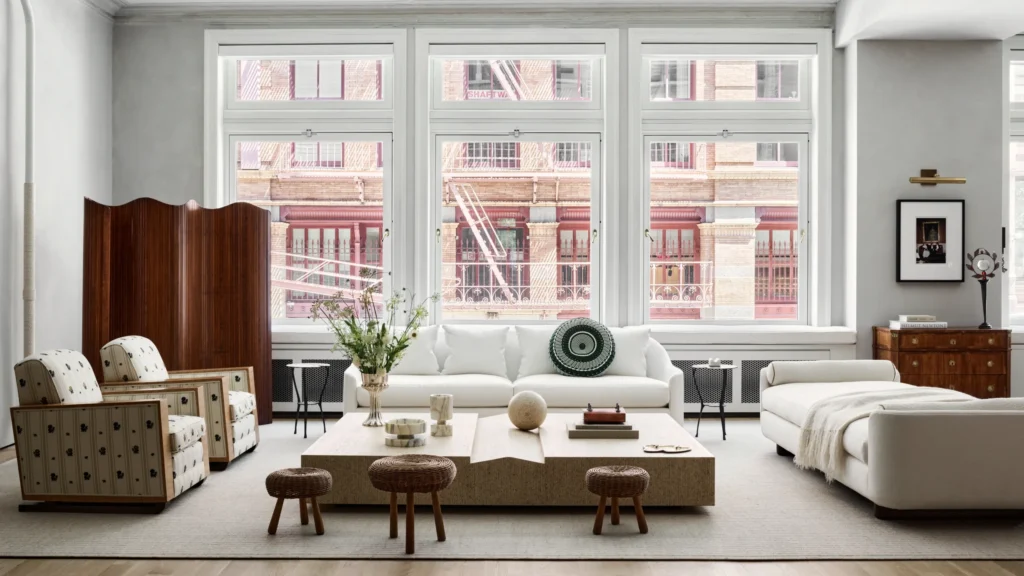
This cultural hybridity is evident in the juxtaposition of eras and aesthetics: a Bauhaus-inspired armchair paired with contemporary art, or bespoke millwork set against original architectural details. The result is not eclecticism for its own sake, but a curated balance that speaks to the city’s intellectual and artistic lineage.
Urban Constraints as Design Catalysts
Space constraints are often cited as the defining challenge of New York living rooms. Yet, for seasoned designers, these constraints act as catalysts for creativity. Ceiling heights, window placements, and structural columns inform layouts that prioritize flow and visual continuity.
- Open-plan configurations that merge living, dining, and study zones
- Custom-built storage integrated seamlessly into walls
- Furniture scaled precisely to maintain openness and comfort
In this context, the modern living room becomes less about size and more about proportion, light, and intentionality.
Defining the Modern Living Room in New York
The modern living room in New York is characterized by restraint rather than excess. Clean lines, tactile materials, and a nuanced color palette form the foundation of spaces that feel both sophisticated and deeply personal. Neutral tones—stone, taupe, charcoal—are often punctuated by curated accents that add warmth and individuality.
Lighting plays a pivotal role. With natural light at a premium, especially in dense neighborhoods, layered lighting schemes combine architectural fixtures, sculptural floor lamps, and discreet wall lighting to create depth and ambiance throughout the day.
Materiality and Texture
Material choices in New York living rooms tend toward authenticity and longevity. Designers favor materials that age gracefully and add sensory richness:
- Natural woods with matte finishes
- Stone and travertine surfaces
- Textiles such as bouclé, linen, and wool
These materials ground the space, offering a counterpoint to the city’s relentless pace and technological sheen.
Living Room Furniture: Precision, Comfort, and Expression
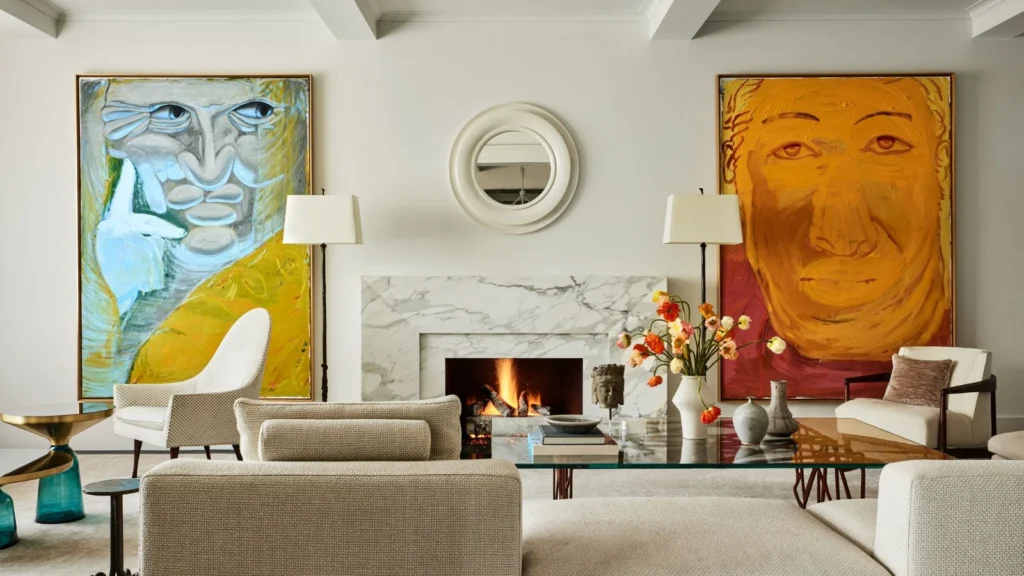
In New York interiors, living room furniture is never incidental. Each piece is selected not only for aesthetic coherence but for its ability to adapt to multifunctional living. Seating, in particular, must balance comfort with visual lightness, supporting both everyday relaxation and social gatherings.
Low-profile sofas, sculptural armchairs, and modular systems dominate contemporary spaces, allowing for flexible arrangements that evolve with the resident’s needs. The emphasis is on craftsmanship and form—furniture that functions as both utility and art.
Key Principles in Furniture Selection
- Scale: Pieces proportioned to the room, avoiding visual heaviness
- Versatility: Modular or multi-use designs that support urban lifestyles
- Timelessness: Forms that transcend trends and remain relevant over time
In high-end New York living rooms, furniture often becomes the anchor around which the entire spatial narrative is built.
Layout Strategies for Intimate Urban Spaces
Successful New York living rooms are defined by thoughtful layouts that maximize both function and atmosphere. Rather than centering the room solely around a television, designers increasingly prioritize conversation and visual balance.
Zoning Without Walls
In open-plan apartments, zoning is achieved through furniture placement, area rugs, and lighting rather than physical partitions. A carefully positioned sofa can define the living area, while a console or bookshelf subtly separates it from adjacent zones.
This approach preserves openness while creating distinct, intimate environments within a single space.
Views as Design Elements
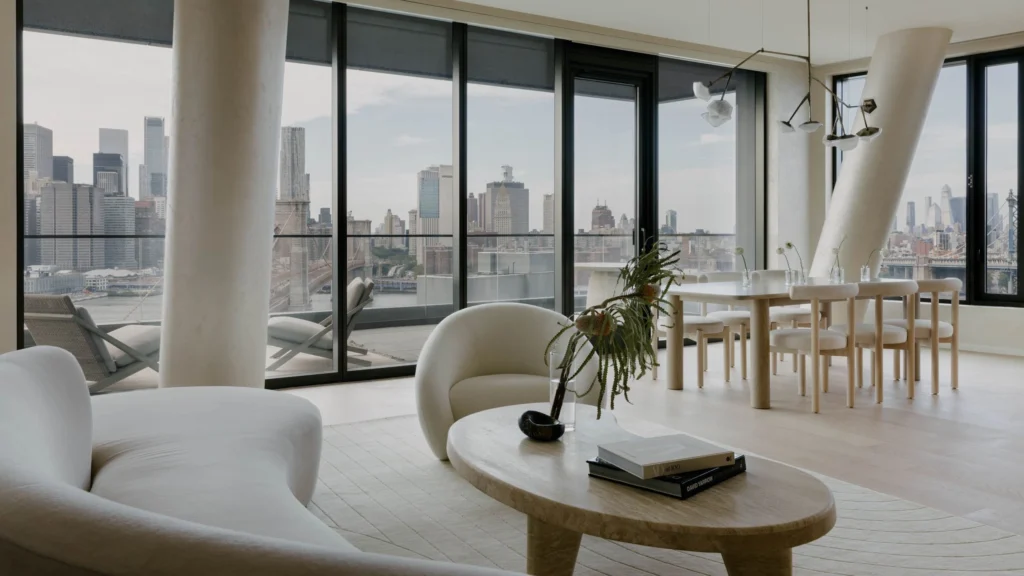
When city views are available, they become integral to the living room composition. Furniture is oriented to frame skyline vistas or historic streetscapes, reinforcing the connection between interior and exterior. Even in apartments without expansive views, designers often create focal points through art, fireplaces, or statement lighting.
Historical Context: From Pre-War Elegance to Contemporary Minimalism
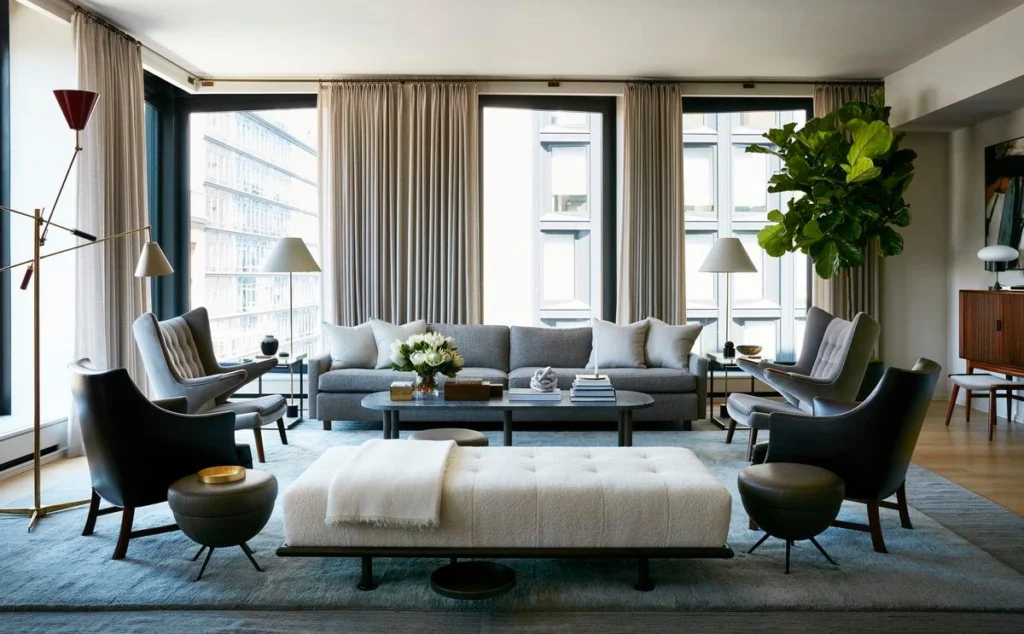
The evolution of the New York living room mirrors the city’s architectural history. Pre-war apartments introduced gracious proportions, detailed moldings, and formal layouts, while post-war modernism emphasized efficiency and openness. Today’s interiors often blend these influences, respecting architectural heritage while embracing contemporary sensibilities.
According to the Architectural Digest, New York continues to set global benchmarks for residential design by merging historical context with forward-thinking innovation. This synthesis is particularly evident in living rooms that honor original details while introducing modern furniture and technology.
Designing for Well-Being in the Urban Home
Beyond aesthetics, the modern New York living room increasingly addresses well-being. Acoustics, air quality, and tactile comfort are integral considerations, reflecting a broader shift toward holistic interior design.
- Soft furnishings that absorb sound and enhance acoustic comfort
- Natural materials that promote sensory calm
- Layouts that encourage relaxation and mindful living
In a city that rarely sleeps, the living room becomes a restorative environment—a place to slow down without disengaging from urban life.
Global Influence and Local Identity
While deeply rooted in its urban context, the New York living room resonates globally. International clients and designers draw inspiration from these interiors, adapting their principles to cities such as London, Paris, and Hong Kong. What distinguishes New York, however, is its confidence in juxtaposition—old and new, minimal and expressive, global and local.
This duality ensures that New York living rooms remain relevant references for contemporary design discourse, offering lessons in adaptability, refinement, and cultural storytelling.
Intimacy as the New Luxury
As urban living continues to evolve, the New York living room stands as a testament to the power of thoughtful design. It demonstrates that luxury is no longer defined by scale alone, but by intimacy, quality, and intentionality. Through refined layouts, carefully chosen living room furniture, and a deep respect for context, these spaces redefine what it means to live well in the city.
For design professionals and discerning homeowners alike, New York living rooms offer enduring inspiration—proof that even within the world’s most dynamic metropolis, there is room for calm, character, and cultivated living.