

In Milanese apartment design, the boundaries between dining and living have never been rigid. Instead, they dissolve into a sophisticated choreography of movement, light, and material. In the heart of Italy’s design capital, open-plan living is not simply a spatial solution—it is a cultural statement rooted in conviviality, craftsmanship, and contemporary elegance. From historic palazzi near Brera to newly reimagined residences in Porta Nuova, Italian interior design continues to redefine how modern households gather, entertain, and inhabit space.
For architects, interior designers, and discerning homeowners, the Milanese approach offers a compelling blueprint for contemporary European interiors: fluid, layered, and deeply intentional. This article explores how Milanese homes blend dining and living into one cohesive environment—balancing heritage and innovation while setting a global benchmark for refined urban living.
The Cultural Foundations of Milanese Open-Plan Living
To understand Milanese apartment design, one must first understand Milan itself. A city shaped by trade, fashion, and design excellence, Milan values both efficiency and aesthetic integrity. Historically, apartments were organized around generous salons used for receiving guests. Over time, as lifestyles evolved, these salons merged with dining rooms, forming the foundation for today’s open-plan living arrangements.
Unlike purely minimalist layouts, Italian interior design approaches open space with nuance. The goal is not vast emptiness but calibrated openness—rooms that flow into one another while preserving intimacy. In many contemporary European interiors, this balance is achieved through subtle architectural cues rather than physical walls.
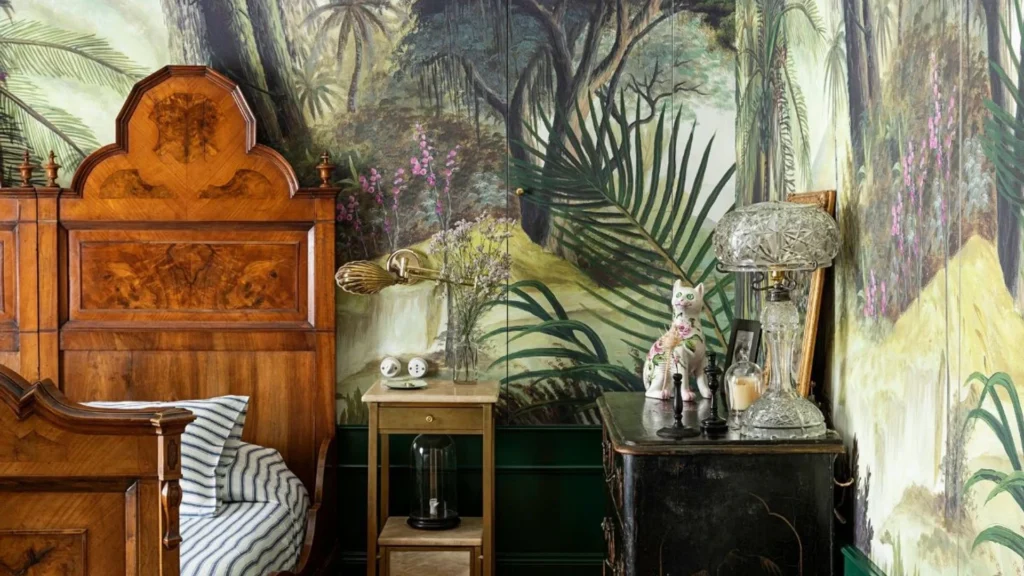
Hospitality as Spatial Philosophy
In Milan, hospitality is embedded in the architecture. Dining is not isolated; it is integrated. Aperitivo transitions seamlessly into dinner, and conversation extends from table to sofa without interruption. This cultural rhythm directly informs Milanese apartment design, where furniture placement, lighting, and circulation are orchestrated to support social fluidity.
Architectural Strategies That Create Fluidity
1. Partial Dividers and Architectural Filters
Rather than erecting full partitions, designers employ architectural filters—glass panels, sliding doors, open shelving, or sculptural columns. These elements define zones within open-plan living environments while preserving visual continuity.
- Ribbed or fluted glass partitions that diffuse light
- Custom millwork shelving acting as permeable dividers
- Textile curtains for flexible enclosure
- Metal-framed sliding panels referencing industrial Milan
This layered approach is a hallmark of Italian interior design, ensuring that each functional area retains identity within the larger spatial narrative.
2. Ceiling Treatments and Flooring Transitions
In refined Milanese apartment design, ceilings and floors quietly demarcate zones. Herringbone parquet may anchor the living area, while stone or terrazzo subtly defines the dining zone. Similarly, recessed ceiling details or sculptural lighting installations guide the eye without interrupting flow.
These understated gestures typify contemporary European interiors, where materiality becomes the language of separation.
3. Centralized Dining as Spatial Anchor
In many Milan residences, the dining table occupies a pivotal position—often between kitchen and living area. This central placement transforms the table into a social fulcrum, reinforcing the principles of open-plan living.
Round or oval tables are frequently favored in Milanese apartment design, encouraging conversation and improving circulation. The choice reflects the Italian emphasis on dialogue and shared experience.
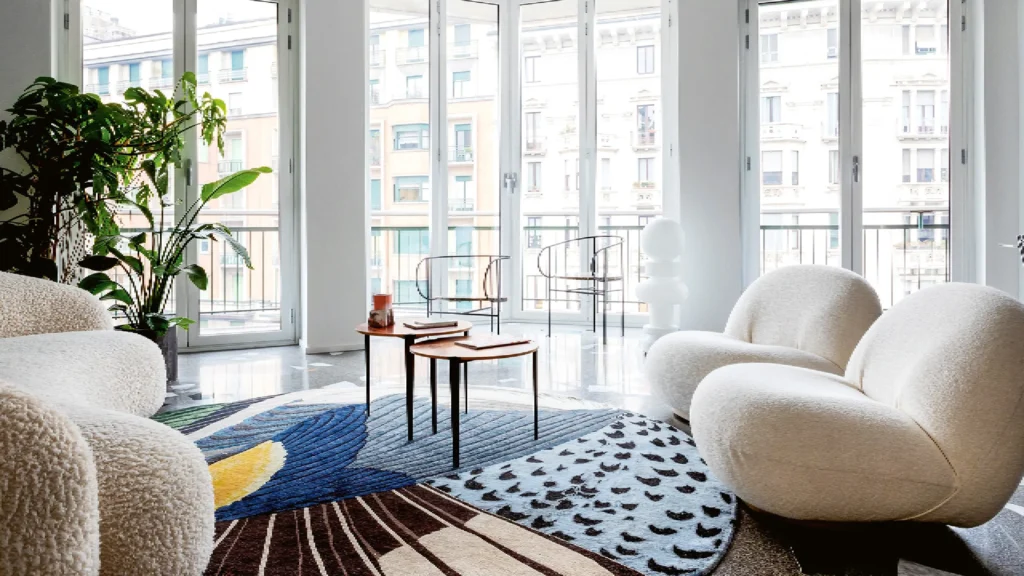
Material Harmony: The Signature of Italian Interior Design
Material continuity is essential in blending dining and living areas. Italian interior design privileges tactility—walnut, travertine, brushed brass, velvet, and lacquer—layered with restraint. Rather than abrupt contrasts, Milanese homes favor tonal gradations that unify the entire open-plan living space.
For example:
- A travertine dining table echoing a stone coffee table
- Walnut cabinetry extending into a media console
- Brass accents repeated in lighting and hardware
- Neutral textiles bridging lounge and dining seating
Such continuity defines contemporary European interiors and ensures that Milanese apartment design feels cohesive rather than compartmentalized.
Lighting as a Unifying Framework
Lighting in Milanese apartment design is architectural. It sculpts atmosphere while clarifying function. A statement pendant above the dining table coexists with sculptural floor lamps and recessed ambient lighting in the lounge area. Together, they create layers that reinforce open-plan living without visual fragmentation.
Many of these principles are showcased annually during Salone del Mobile.Milano, where leading studios present innovations that influence Italian interior design globally. The fair demonstrates how lighting can articulate zones within contemporary European interiors while maintaining a unified aesthetic language.
Furniture as Architectural Element
Curated, Not Crowded
In Milanese apartment design, furniture placement defines spatial flow. Sofas often float centrally rather than hugging walls, acting as soft partitions between lounge and dining zones. Sideboards or console tables may subtly frame the transition.
The philosophy of open-plan living here is disciplined: fewer pieces, chosen with intention. Each object must justify its presence through proportion, craftsmanship, and material resonance—core tenets of Italian interior design.
Symmetry and Asymmetry in Dialogue
Dining chairs might introduce sculptural curves, while the adjacent living area maintains clean-lined seating. This interplay of forms enlivens contemporary European interiors without disrupting cohesion. The result is a space that feels dynamic yet harmonious.
Color Palettes That Enhance Continuity
Color in Milanese apartment design is sophisticated and restrained. Warm neutrals—ivory, taupe, greige—establish a base, while deeper hues such as forest green, terracotta, or midnight blue add depth. These tones extend across dining and living areas to reinforce open-plan living cohesion.
Rather than accent walls, Italian interior design often introduces color through upholstery, art, and rugs. This approach maintains flexibility while preserving the visual unity characteristic of contemporary European interiors.
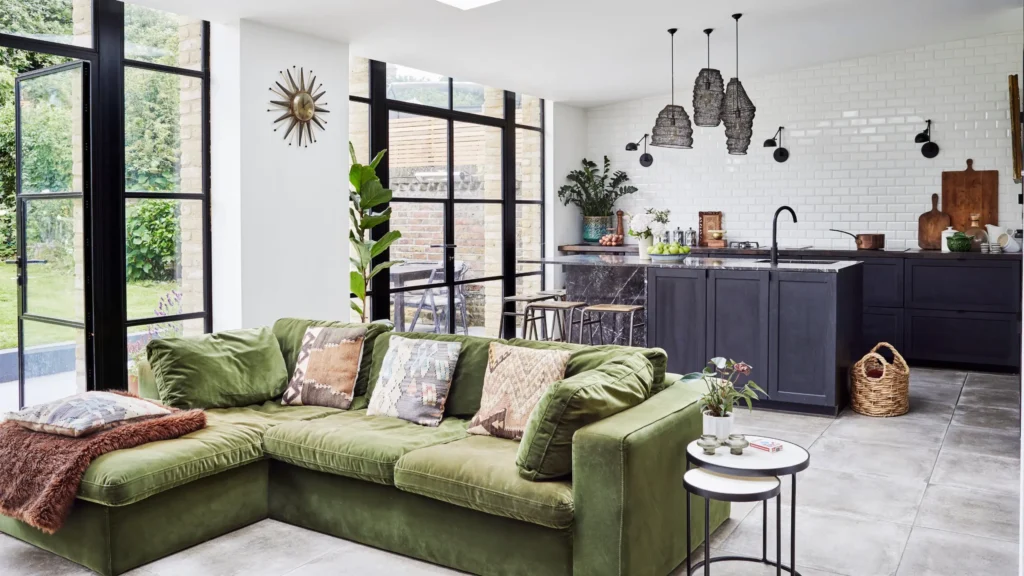
Art and Collectibles as Spatial Connectors
Art is integral to Milanese apartment design. Large-scale works frequently span both dining and living zones, acting as visual bridges. Sculptures positioned between areas further dissolve boundaries, enhancing the philosophy of open-plan living.
In many Italian interior design projects, curated collections reflect the homeowner’s cultural literacy—reinforcing Milan’s reputation as a nexus of art, fashion, and design. These curated gestures elevate contemporary European interiors from functional spaces to personal galleries.
Practical Considerations for Architects and Developers
Acoustic Balance
One challenge of open-plan living is acoustics. In high-end Milanese apartment design, acoustic panels, upholstered surfaces, and area rugs mitigate sound transfer between dining and lounge areas. These solutions maintain comfort without compromising the aesthetics of Italian interior design.
Kitchen Integration
Often, the kitchen forms part of the same visual field. Concealed cabinetry and integrated appliances preserve the elegance expected in contemporary European interiors. Sliding panels may hide preparation zones during formal gatherings, reinforcing the adaptable nature of open-plan living.
Circulation and Proportion
Successful Milanese apartment design depends on generous circulation paths. A minimum clearance of 90–120 cm around dining tables ensures ease of movement between zones. Such spatial discipline is foundational to refined Italian interior design.
Why Milan Sets the Standard for Contemporary European Interiors
Milan’s influence extends far beyond Italy. Its interpretation of open-plan living—rooted in culture, craftsmanship, and social ritual—has shaped contemporary European interiors across Paris, London, and beyond. What distinguishes Milanese apartment design is not merely openness but orchestration: a deliberate layering of architecture, furniture, material, and light.
For high-net-worth individuals and real estate developers, this model offers enduring value. Properties that embody the principles of Italian interior design—fluid layouts, material integrity, and curated furnishings—remain timeless and internationally desirable.
The Elegance of Seamless Living
The fusion of dining and living within Milanese apartment design reflects a broader philosophy of life—one that privileges connection, beauty, and thoughtful functionality. Through calibrated open-plan living strategies, masterful Italian interior design, and an unwavering commitment to material excellence, Milan continues to define the essence of contemporary European interiors.
For architects, designers, and global homeowners seeking inspiration, the Milanese model offers more than aesthetic guidance. It provides a cultural framework for living well—where dining and conversation, architecture and artistry, merge into one fluid, harmonious space.