

Marbella has long transcended its reputation as a sun-drenched resort town to become one of Europe’s most sophisticated luxury real estate markets. Here, high-value property design is no longer defined by surface-level opulence, but by the intelligence of architectural vision and the cultural depth of interior design. In a region where discerning international buyers compare Marbella not only to the French Riviera or Lake Como, but also to Miami and Dubai, design has become a decisive factor in how value is perceived, sustained, and amplified.
For architects, interior designers, and real estate professionals, Marbella offers a compelling case study in how design increases property value. Thoughtful spatial planning, material integrity, climate-responsive architecture, and lifestyle-driven interiors now sit at the core of the region’s most desirable properties. This article explores how architecture and interior design elevate Marbella luxury villas beyond real estate assets, transforming them into cultural statements and long-term investments.
The Architectural Language of Value in Marbella
Architecture is the first narrative a property communicates. In Marbella, where landscape, light, and legacy converge, architectural decisions carry direct financial implications. High-value properties are increasingly defined by restraint, proportion, and contextual sensitivity rather than by excess.
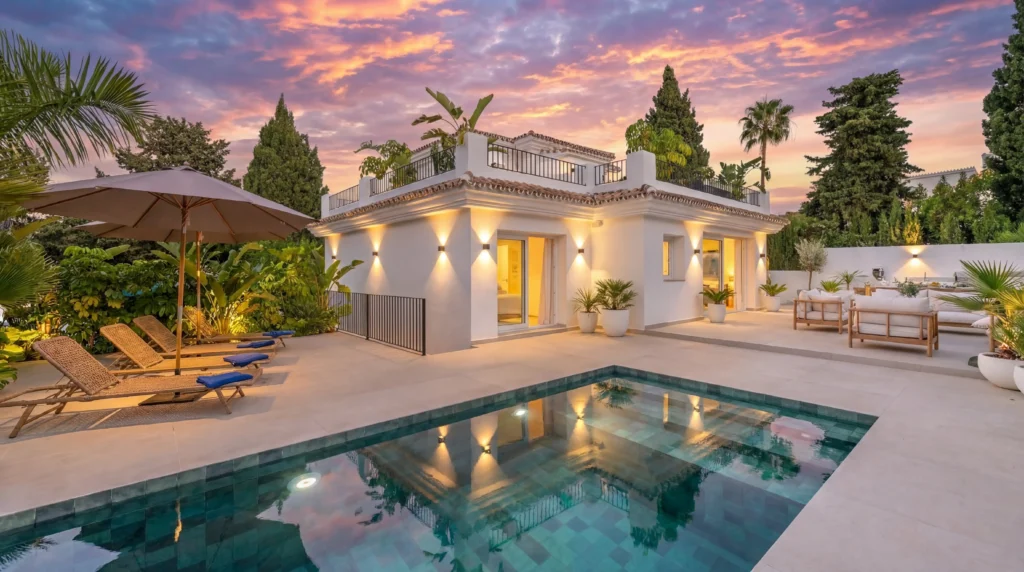
From Mediterranean Heritage to Contemporary Precision
The most successful Marbella luxury villas reinterpret traditional Andalusian forms through a contemporary lens. Courtyards, shaded terraces, and thick walls once designed for climate control are now reimagined with advanced engineering, minimal profiles, and seamless indoor-outdoor transitions.
This synthesis of heritage and modernity resonates strongly with international buyers seeking authenticity without compromise. According to Architectural Digest, properties that balance local identity with global design standards consistently outperform trend-driven developments in long-term valuation.
Site-Specific Architecture as a Value Multiplier
In high-end residential design, context is capital. Marbella’s top-tier properties are increasingly shaped by their specific orientation, topography, and views of the Mediterranean or surrounding mountains. Architecture that responds precisely to its site enhances both experiential quality and market value.
- Optimized solar orientation reduces energy consumption while enhancing interior comfort.
- Terraced volumes preserve views and privacy simultaneously.
- Architectural framing of landscape increases emotional and perceived value.
This site-driven approach underscores how high-value property design is inseparable from environmental intelligence.
Interior Design as a Strategic Investment Tool
If architecture establishes a property’s identity, interior design determines its emotional resonance and commercial performance. In Marbella, interiors are no longer decorative afterthoughts but strategic instruments that influence buyer psychology and price positioning.
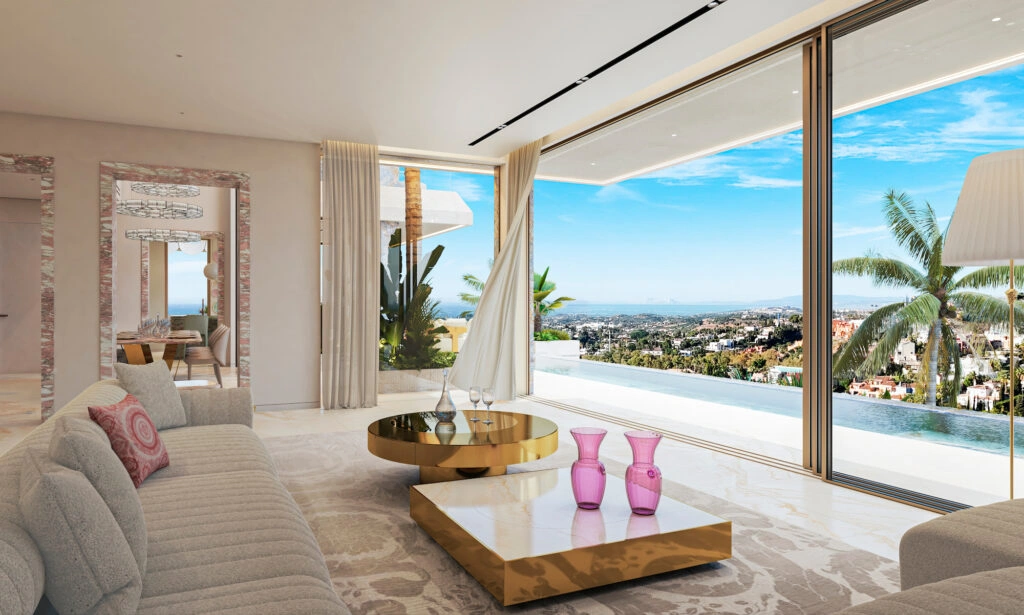
Spatial Flow and Lifestyle Alignment
Today’s high-net-worth buyers prioritize how a space supports daily rituals, entertaining, and retreat. Open-plan living areas, adaptable private zones, and seamless circulation patterns are central to how design increases property value.
Interior layouts in Marbella luxury villas increasingly reflect international lifestyles:
- Fluid transitions between kitchen, dining, and outdoor living spaces.
- Primary suites designed as private sanctuaries rather than bedrooms.
- Wellness-oriented spaces such as spas, gyms, and meditation rooms.
These spatial decisions directly impact dwell time during viewings, emotional attachment, and ultimately, willingness to pay a premium.
Material Integrity and Sensory Sophistication
Luxury today is experienced through the senses. Natural stone, tactile woods, artisanal textiles, and custom finishes define the most compelling interiors in Marbella. Beyond aesthetics, material authenticity signals longevity, sustainability, and cultural discernment.
In high-value property design, materials are chosen not only for visual impact but for how they age, perform, and contribute to the narrative of the home. This approach aligns with a global shift toward “quiet luxury,” where refinement is recognized intuitively rather than announced overtly.
The Role of Design in Property Valuation and Market Positioning
In Marbella’s competitive luxury market, design quality is increasingly embedded into valuation models. Properties with coherent architectural and interior concepts consistently achieve higher price-per-square-meter figures and shorter time-on-market.
Design Consistency as a Marker of Excellence
One of the most overlooked yet critical factors in how design increases property value is consistency. High-value properties present a unified design language across architecture, interiors, landscaping, and furnishings.
For investors and developers, this coherence reduces perceived risk for buyers. A property that feels complete and intentional signals professional execution and long-term durability.
Turnkey Design and International Buyer Confidence
Marbella attracts a global clientele, many of whom purchase properties remotely or as secondary residences. Turnkey homes with fully resolved interiors, lighting schemes, and bespoke furniture solutions command higher premiums because they eliminate uncertainty.
In this context, Marbella luxury villas that integrate architecture, interior design, and curated furnishings from the outset outperform properties that require post-purchase customization.
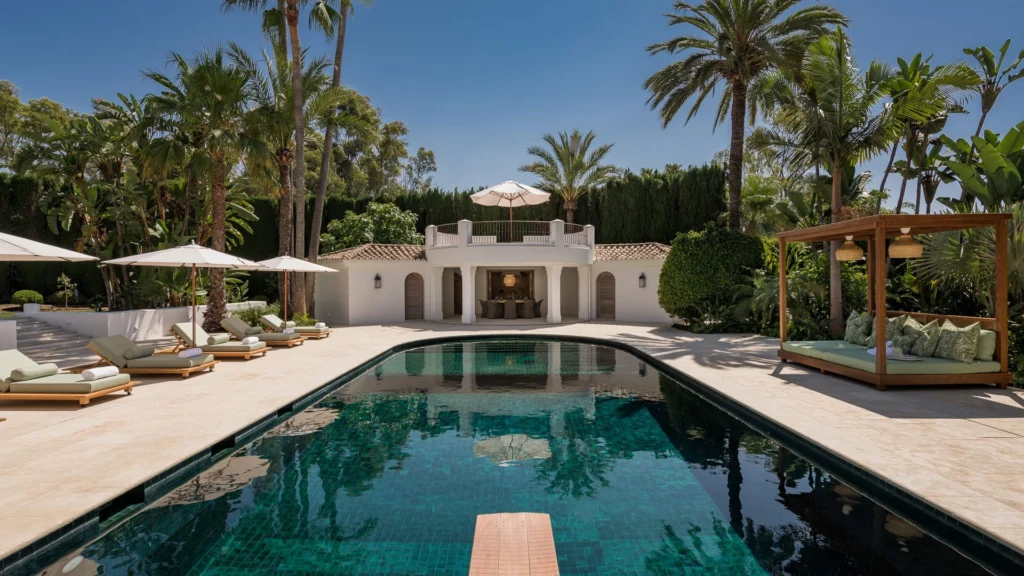
Outdoor Architecture and the Mediterranean Lifestyle Premium
Outdoor spaces are not ancillary in Marbella; they are central to the property’s value proposition. Architecture and interior design increasingly extend beyond walls, shaping terraces, gardens, and pool areas as fully furnished living environments.
Designing for Climate, Comfort, and Continuity
High-performing properties treat outdoor areas with the same rigor as interiors. Shaded pergolas, weather-resistant materials, and thoughtfully designed transitions allow year-round use.
- Outdoor dining areas designed as architectural rooms.
- Poolscapes integrated into the home’s visual axis.
- Landscape design aligned with interior palettes and materials.
This holistic approach reinforces high-value property design by maximizing usable square footage and enhancing lifestyle appeal.
Sustainability, Technology, and the Future of Luxury in Marbella
Design-driven value in Marbella is increasingly tied to sustainability and intelligent technology. Energy efficiency, water management, and smart home systems are no longer optional upgrades but baseline expectations in the upper market.
Sustainable Design as a Value Safeguard
Properties that integrate passive cooling, renewable energy systems, and durable materials are better positioned to retain value amid regulatory and environmental shifts. For international buyers, sustainability also carries cultural and ethical significance.
In this sense, how design increases property value is not limited to immediate market perception but extends to long-term resilience.
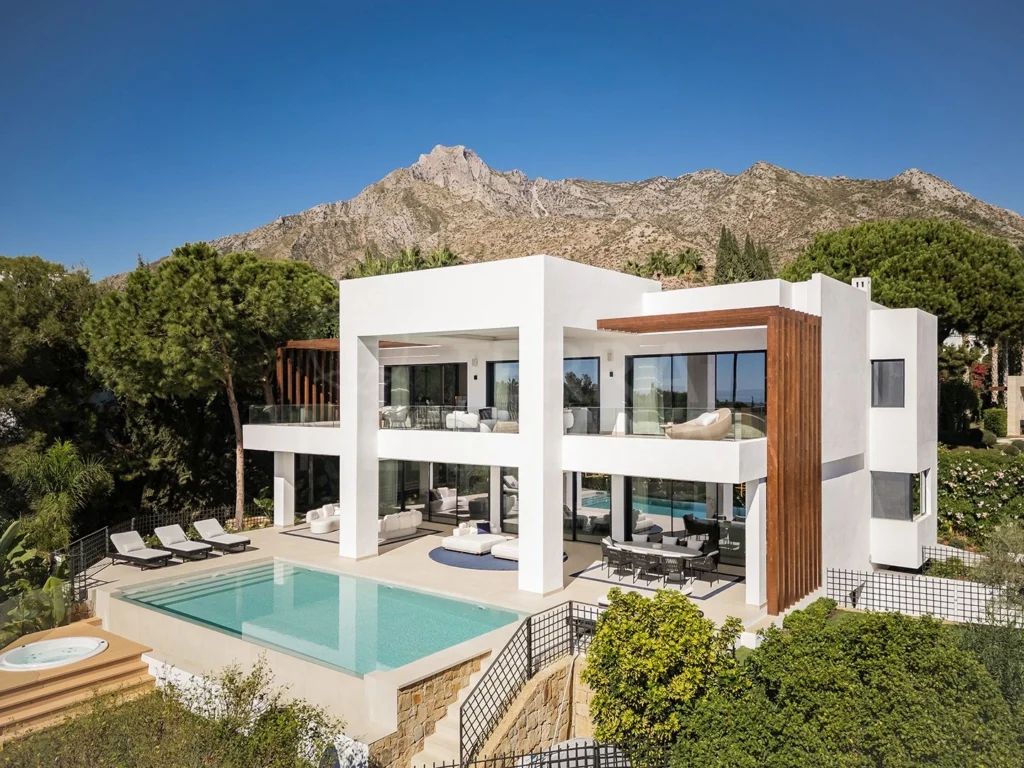
Discreet Technology, Elevated Living
The most refined Marbella luxury villas incorporate technology invisibly. Automated shading, climate control, and security systems enhance comfort without disrupting architectural purity.
This discreet integration supports a sense of effortless luxury, reinforcing the property’s status as both a private retreat and a future-proof asset.
Design as Cultural and Financial Capital
In Marbella, architecture and interior design function as both cultural expression and economic strategy. High-value properties succeed when they move beyond spectacle to deliver spatial intelligence, material integrity, and lifestyle resonance.
For professionals and investors alike, understanding high-value property design is essential to navigating Marbella’s evolving luxury landscape. The most enduring Marbella luxury villas are those where architecture and interior design work in concert—elevating not only property value, but the lived experience itself.
Ultimately, how design increases property value in Marbella lies in its ability to translate place, culture, and aspiration into spaces that feel both timeless and deeply personal.