

Haussmannian architecture has long shaped the visual and cultural identity of Paris. From its grand boulevards to its rhythmically ordered façades, this 19th-century urban framework continues to define the experience of Parisian apartments today. Yet behind these historic walls, a new design language has been quietly emerging—one that speaks to restraint, clarity, and modern sensibility. Contemporary minimalism, with its emphasis on space, light, and intentionality, has become a compelling counterpoint to the ornamental rigor of classical Paris.
This dialogue between constraint and freedom, heritage and innovation, is now one of the most intellectually stimulating conversations in Paris interiors. For architects, interior designers, and discerning homeowners, the challenge is not to erase history, but to reinterpret it—carefully, intelligently, and with cultural respect. The result is a refined synthesis where historic frameworks host contemporary lifestyles without visual conflict.
Understanding the Haussmannian Framework
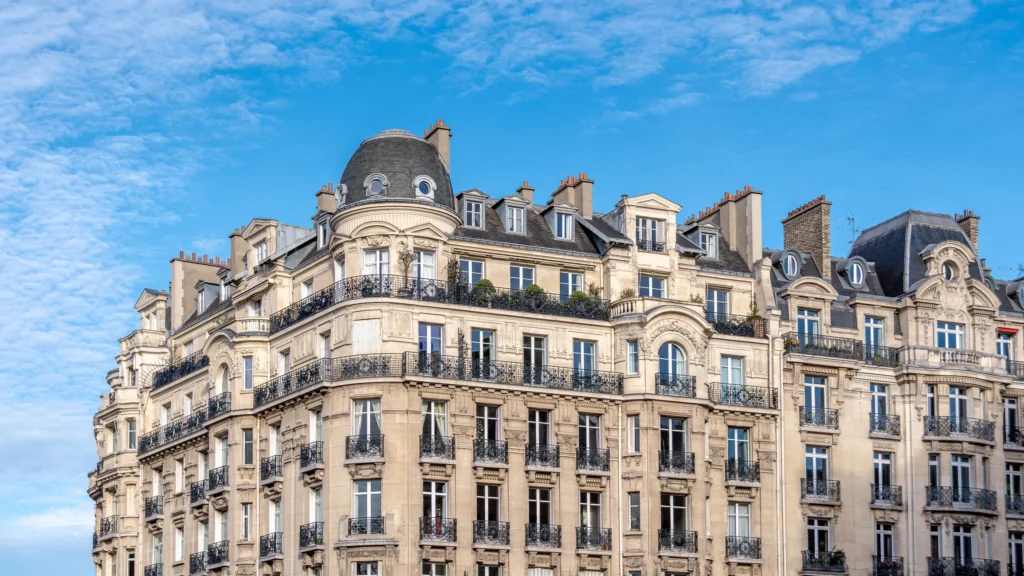
Commissioned under Napoleon III and executed by Baron Georges-Eugène Haussmann, Haussmannian architecture was conceived as a rational, hygienic, and visually unified response to a rapidly modernizing city. Its principles were strict, codified, and urban in scale, yet deeply influential on domestic interiors.
Defining Characteristics of Haussmannian Architecture
Within Parisian apartments, the Haussmannian legacy manifests through a consistent set of architectural elements that continue to define value and prestige:
- High ceilings, often exceeding three meters, designed for air circulation and grandeur
- Original parquet flooring in herringbone or point de Hongrie patterns
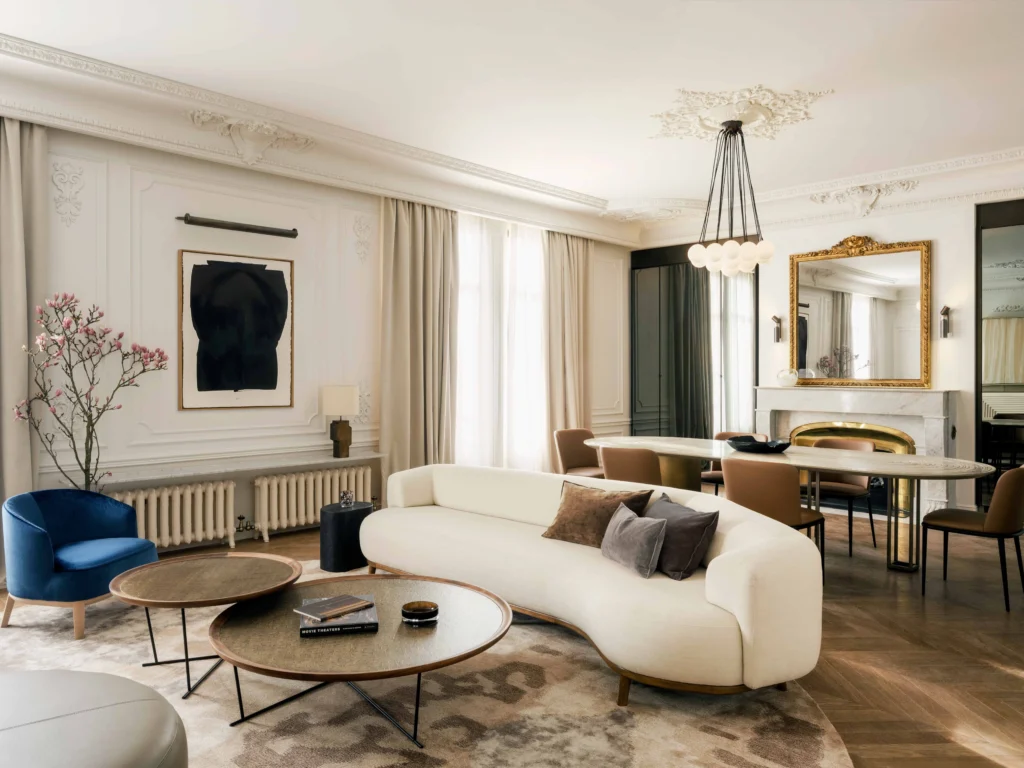
- Ornamental plaster moldings, ceiling rosettes, and wall paneling
- Symmetrical room sequences aligned along formal axes
- Large windows with wrought-iron balconies maximizing natural light
These features are not merely decorative; they are structural and often protected. For contemporary designers, they represent both an opportunity and a constraint—elements that cannot be ignored, removed, or trivialized.
Constraints as a Creative Catalyst
In contrast to open-plan modern constructions, Parisian apartments within Haussmannian buildings impose spatial hierarchies and fixed proportions. Load-bearing walls, chimney breasts, and strict preservation rules shape what is possible. However, it is precisely within these limits that contemporary minimalism finds its intellectual strength.
Minimalism in Paris does not seek emptiness; it seeks clarity. By reducing visual noise, designers allow historic details to breathe. Ornament is no longer layered upon ornament; instead, it is framed, isolated, and respected.
The Philosophy of Contemporary Minimalism in Paris Interiors
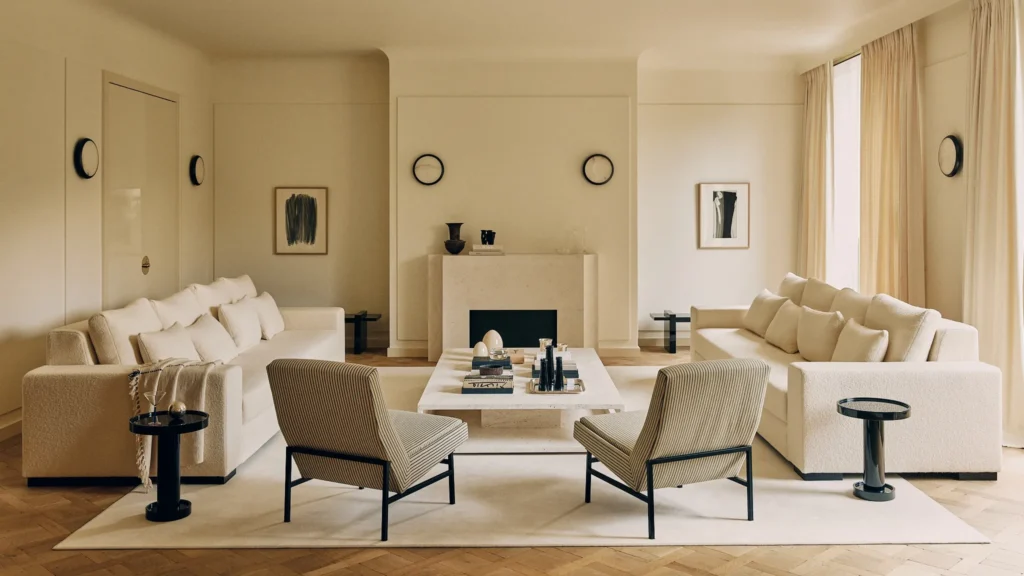
Unlike its colder, more austere interpretations elsewhere, contemporary minimalism in Paris interiors is nuanced and contextual. It is guided by principles rather than aesthetics alone:
- Reduction, not erasure: preserving architectural features while simplifying everything else
- Material integrity: prioritizing stone, wood, linen, and metal in honest finishes
- Spatial legibility: reinforcing circulation and proportions through light and color
- Functional elegance: furniture and objects chosen for purpose as much as form
This approach aligns seamlessly with the intellectual expectations of a global audience that values authenticity over spectacle.
Reframing Ornament Through Minimalism
One of the central tensions in merging Haussmannian architecture with contemporary minimalism lies in the treatment of ornamentation. Ceiling moldings, cornices, and wall paneling are intrinsic to Parisian apartments, yet they can easily overwhelm a contemporary vision if handled without restraint.
Monochrome Palettes and Architectural Emphasis
A widely adopted strategy in Paris interiors is the use of monochromatic or tonal color schemes—often whites, warm greys, or mineral hues. By applying a single color across walls, moldings, and ceilings, designers dissolve visual boundaries and allow form to take precedence over decoration.
This technique does not neutralize history; it abstracts it. Architectural elements become sculptural rather than ornamental, aligning seamlessly with minimalist principles.
Spatial Reconfiguration Within Historic Limits
Modern living demands flexibility—open kitchens, integrated living spaces, and fluid transitions. Achieving this within Haussmannian architecture requires both technical expertise and cultural sensitivity.
Selective Openness in Parisian Apartments
Rather than fully demolishing internal partitions, designers often opt for strategic openings:
- Widened doorways that preserve symmetry while improving flow
- Glass or steel-framed partitions that maintain visual continuity
- Aligned sightlines that enhance depth without altering structure
These interventions respect the original spatial logic of Parisian apartments while accommodating contemporary lifestyles.
Furniture as an Architectural Extension
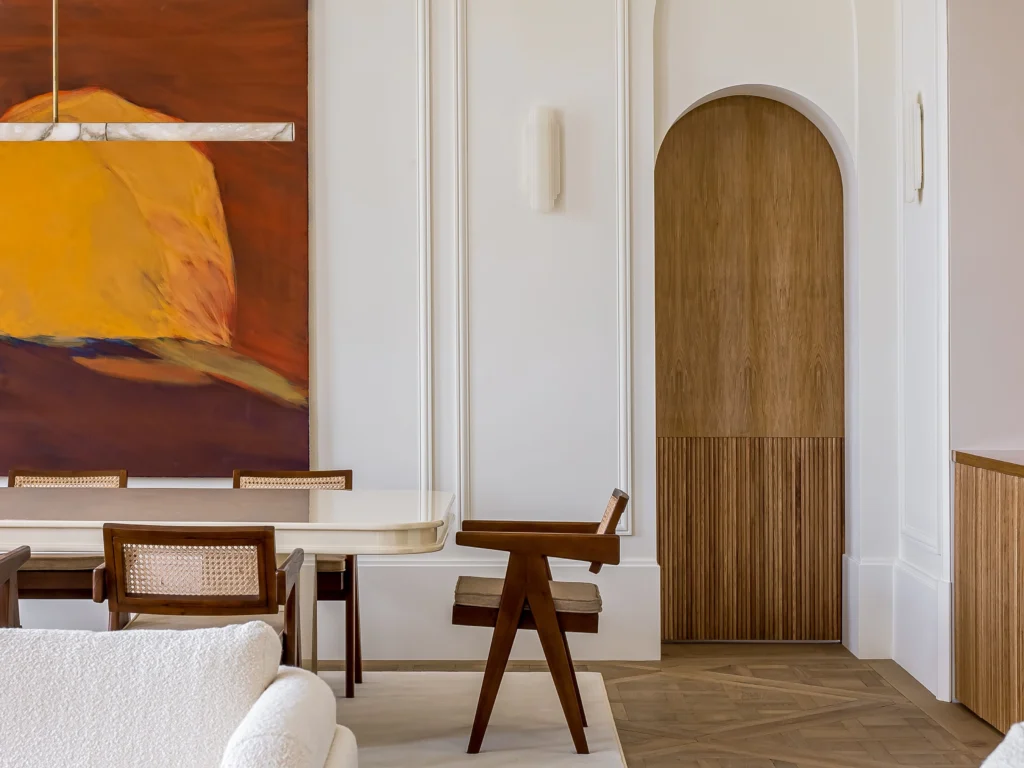
In minimalist Paris interiors, furniture selection becomes an architectural act. Pieces are chosen not to decorate, but to reinforce proportion, rhythm, and balance. Low-profile seating emphasizes ceiling height; linear tables echo wall paneling; bespoke cabinetry aligns precisely with moldings.
The result is an interior where furniture feels inevitable rather than imposed—an extension of the space itself.
Light, Silence, and the Luxury of Restraint
True luxury in contemporary Paris is increasingly associated with calm. Contemporary minimalism responds to this desire by privileging light, acoustic comfort, and visual silence. In Haussmannian architecture, tall windows already provide abundant daylight; minimalist interiors amplify this advantage by removing excess and enhancing reflection.
Global Appeal and Cultural Intelligence
The international fascination with Parisian apartments lies not only in their beauty, but in their cultural depth. For global homeowners and investors, interiors that merge Haussmannian architecture with contemporary minimalism signal sophistication, discernment, and long-term value.
These spaces speak a universal design language while remaining unmistakably Parisian—a balance that resonates across cultures and markets.
The intersection of Haussmannian architecture and contemporary minimalism is not a stylistic compromise; it is a disciplined conversation between eras. Within Parisian apartments, constraint becomes a source of creativity, and history becomes a framework for modern expression.
For today’s architects, designers, and globally minded clients, this approach offers more than aesthetic pleasure. It provides a model for respectful innovation—one that honors the past while articulating the values of contemporary life. In the evolving narrative of Paris interiors, minimalism does not replace heritage; it reveals it.