

In the rarefied world of Geneva lakefront homes, architecture does more than shelter; it frames a dialogue between interior space and the vast serenity of water and sky. Along the shores of Lake Geneva—where alpine light refracts across glass façades and private gardens descend toward quiet docks—the question is not whether one should orient furniture toward the view, but how to do so with nuance, intention, and architectural intelligence.
For architects, interior designers, and discerning homeowners, the living room seating arrangement becomes a decisive gesture. A sofa angled toward the horizon can elevate the entire spatial narrative, transforming a room into a contemplative observatory. Within the context of luxury waterfront interior design, positioning seating toward the panorama is both art and strategy—balancing aesthetics, comfort, circulation, and sightlines.
This editorial explores how to choreograph sofas and seating within Geneva’s most prestigious residences, ensuring that every perspective honors the lake while preserving intimacy and sophistication.
The Lake as Architectural Axis
One of the defining characteristics of Geneva lakefront homes is the intentional alignment of architecture toward the water. Expansive glazing, sliding glass walls, and cantilevered terraces dissolve the boundary between interior and exterior. In this context, the sofa becomes an architectural instrument—an extension of the building’s axis.
Rather than placing seating against a wall by default, leading designers treat the lake as the primary focal point. The orientation of sofas should:
- Emphasize uninterrupted sightlines toward the water.
- Preserve access to terraces and balconies.
- Enhance natural light distribution throughout the room.
- Create a sense of ceremonial arrival when entering the space.
In exemplary luxury waterfront interior design, the view is never an afterthought; it is the organizing principle around which furniture composition evolves.
Framing the Panorama: Straight-On vs. Angled Placement
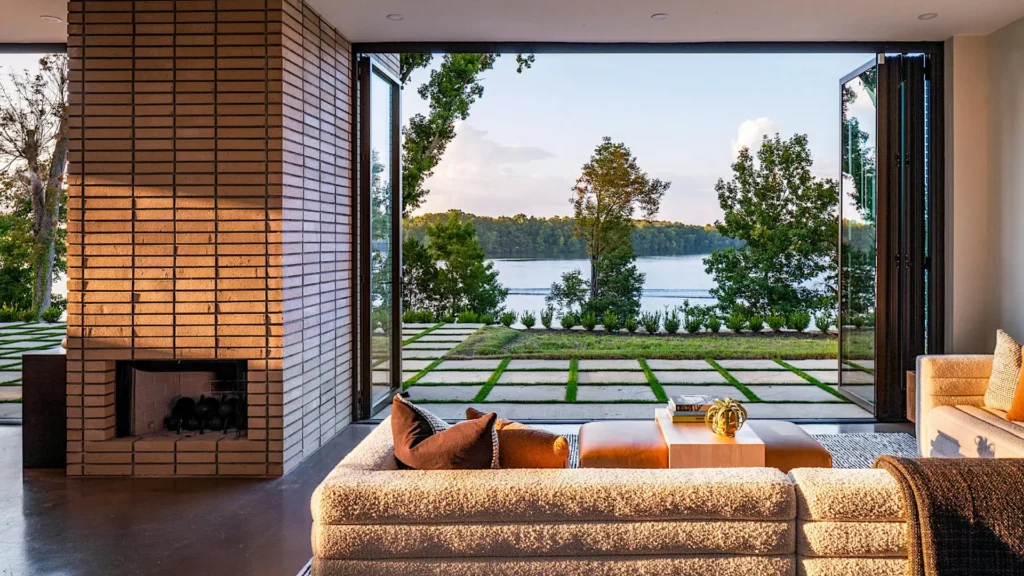
The most direct approach is positioning the primary sofa parallel to the glazing, facing outward. This arrangement establishes clarity and symmetry—particularly effective in contemporary Geneva lakefront homes with minimalist architecture.
However, angled placement can introduce dynamism. By subtly pivoting the sofa 10 to 20 degrees toward a corner window or architectural feature, designers soften the geometry and create layered perspectives. This approach is especially compelling in open-plan environments where the living room seating arrangement must negotiate dining zones or sculptural staircases.
Balancing View and Conversation
While the lake commands attention, the living room must still function as a social environment. An overemphasis on outward orientation risks creating a row-of-seats effect reminiscent of a waiting lounge rather than a private salon.
The most successful living room seating arrangement in Geneva lakefront homes achieves equilibrium between contemplation and conviviality.
Strategies for Social Cohesion
- Floating Sofas: Position the sofa centrally, with its back partially toward the entrance, to define the seating zone while maintaining lake views.
- Dual-Focus Layouts: Pair a lake-facing sofa with perpendicular armchairs, ensuring conversation flows naturally.
- Low-Profile Designs: Opt for lower backrests to avoid obstructing glazing and to maintain visual continuity.
- Curved Configurations: Modular or gently curved sofas subtly embrace both guests and panorama.
In luxury waterfront interior design, modular seating proves particularly effective. It allows spatial flexibility without compromising the axial relationship between interior and water.
Materiality and Light Reflection
Lake Geneva’s shifting light—from crystalline mornings to golden alpine sunsets—demands thoughtful material selection. Sofas positioned toward expansive windows are continuously illuminated, and their finishes must harmonize with this natural spectacle.
In refined Geneva lakefront homes, designers frequently favor:
- Textured bouclé and brushed linen in neutral palettes.
- Soft taupe, stone, and warm ivory tones that echo shoreline hues.
- Subtle metallic accents that reflect but do not compete with sunlight.
- Performance fabrics that resist fading under strong exposure.
The living room seating arrangement thus becomes an atmospheric amplifier. Light interacts with upholstery, reinforcing the ethos of luxury waterfront interior design—one rooted in serenity rather than spectacle.
Transparency and Visual Weight
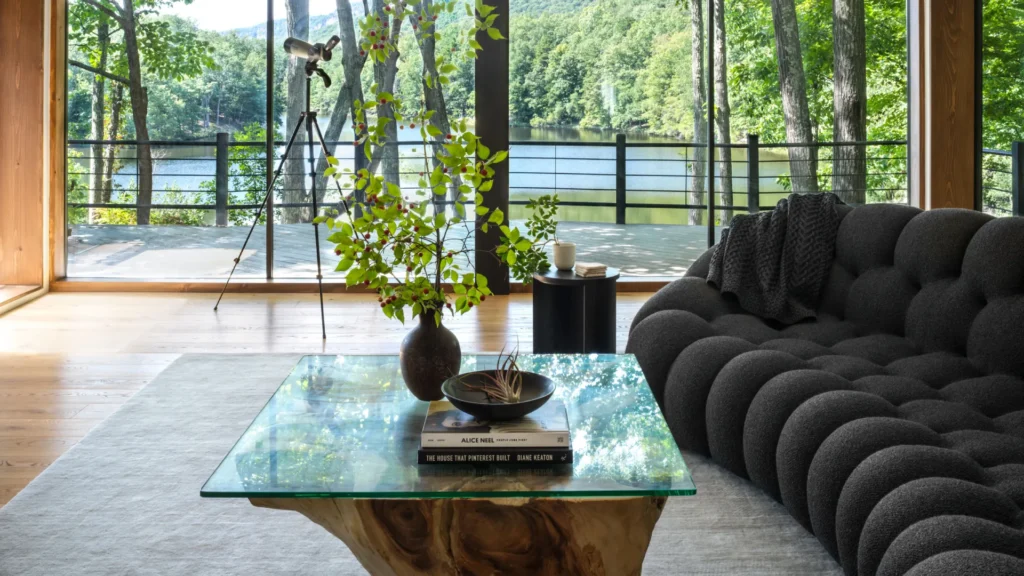
Heavy, high-backed furniture can visually sever the connection to the outdoors. Instead, opt for slender silhouettes, elevated legs, and restrained proportions. In premium Geneva lakefront homes, visual lightness is synonymous with elegance.
Spatial Flow in Open-Plan Residences
Many contemporary Geneva lakefront homes adopt open-plan configurations that integrate kitchen, dining, and lounge areas. In such spaces, the living room seating arrangement must articulate zones without physical barriers.
Defining Zones Through Orientation
A sofa facing the lake can act as a subtle partition. Its back delineates circulation paths while preserving openness. Designers may reinforce this boundary through:
- Area rugs aligned with the seating group.
- Console tables positioned behind sofas.
- Sculptural lighting suspended above the seating zone.
This method exemplifies luxury waterfront interior design: spatial clarity achieved through composition rather than enclosure.
Seasonal Living and Adaptive Arrangements
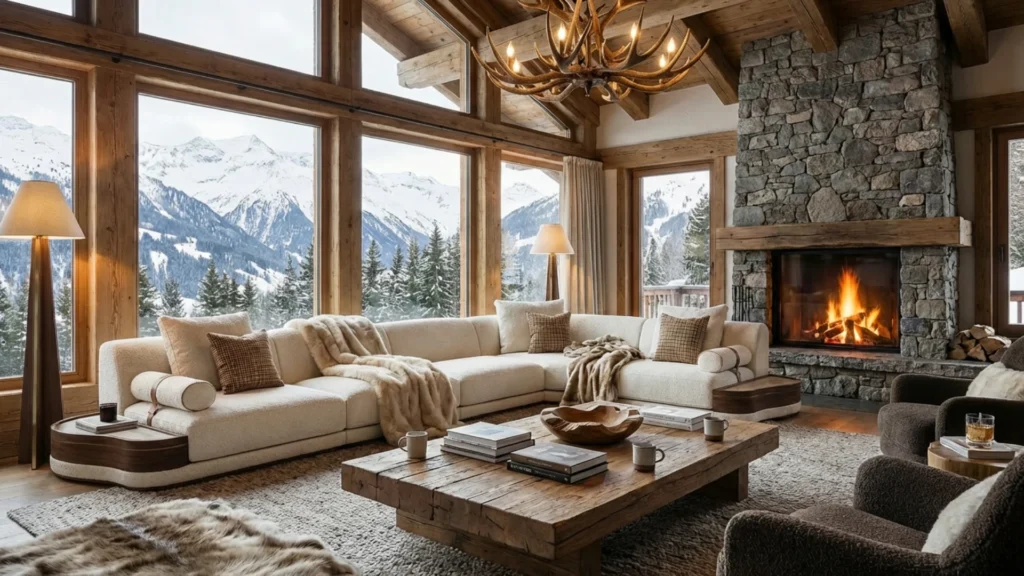
Life on Lake Geneva unfolds with the seasons. Winter snow reframes the landscape in monochrome elegance, while summer invites full transparency with sliding doors open to terraces.
Astute designers plan living room seating arrangement concepts that adapt to seasonal rhythms in Geneva lakefront homes.
Flexible Solutions
- Modular sofas that can be reconfigured for larger gatherings.
- Swivel armchairs allowing occupants to alternate between fireplace and lake views.
- Lightweight ottomans doubling as informal seating or footrests.
Such adaptability reinforces the principles outlined by the ArchDaily architectural platform, which frequently emphasizes flexibility and human-centered spatial design in high-end residential projects.
Architectural Symmetry vs. Organic Flow
Classical villas along the lake often exhibit symmetrical façades and axial gardens. In these residences, symmetry within the living room seating arrangement can echo architectural rigor—twin sofas facing the water, balanced by matching armchairs.
Conversely, contemporary glass pavilions invite asymmetry. A singular, sculptural sectional may follow the geometry of the glazing, enhancing the immersive experience central to luxury waterfront interior design.
Key Considerations for Professionals
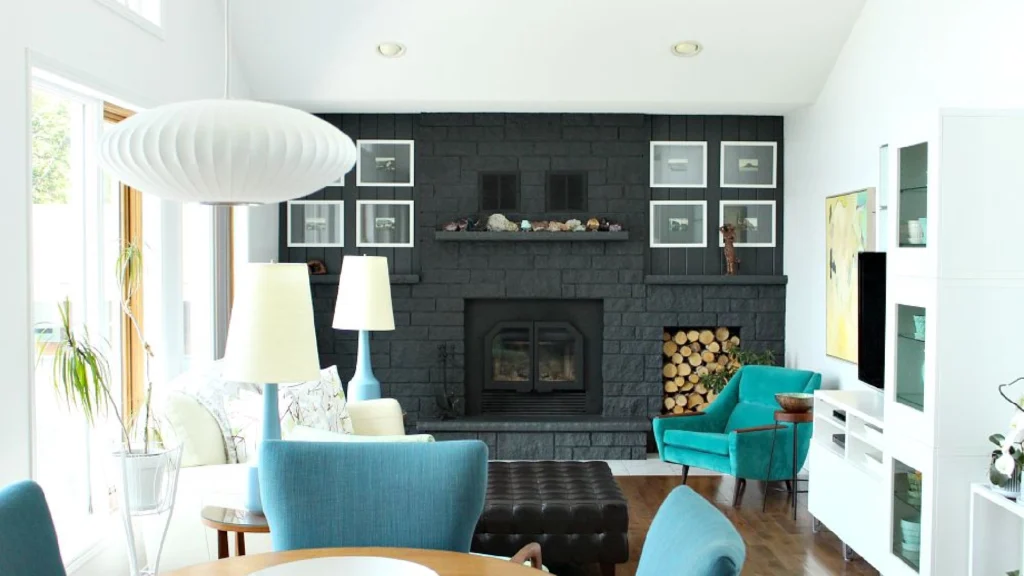
- Respect the structural rhythm of columns and mullions.
- Align primary seating with the strongest view corridor.
- Ensure proportional harmony between furniture scale and ceiling height.
- Consider acoustic treatments to offset expansive glazing.
In Geneva lakefront homes, proportion is paramount. Oversized furniture may dominate, while underscaled pieces risk appearing inconsequential against panoramic backdrops.
Emotional Architecture: Designing for Pause
Beyond technical placement lies emotional resonance. A sofa oriented toward Lake Geneva invites pause—morning coffee at sunrise, reflective evenings as sailboats trace the horizon.
The living room seating arrangement should choreograph these moments. In exceptional Geneva lakefront homes, designers intentionally create micro-experiences:
- A reading corner angled toward distant mountains.
- A chaise extension aligned with sunset trajectories.
- A discreet side table positioned for effortless ritual.
These gestures define luxury waterfront interior design not as opulence, but as calibrated sensitivity to context.
Lighting as Complement to the View
When darkness descends, reflective glazing transforms into mirrors. Artificial lighting must therefore reinforce, not overpower, the original composition.
In the most refined Geneva lakefront homes, designers integrate:
- Low-level floor lamps that preserve sightlines.
- Concealed LED strips enhancing architectural contours.
- Dimmable systems to balance interior glow with nocturnal lake reflections.
The living room seating arrangement remains oriented toward the water, yet layered lighting ensures intimacy. This duality epitomizes thoughtful luxury waterfront interior design.
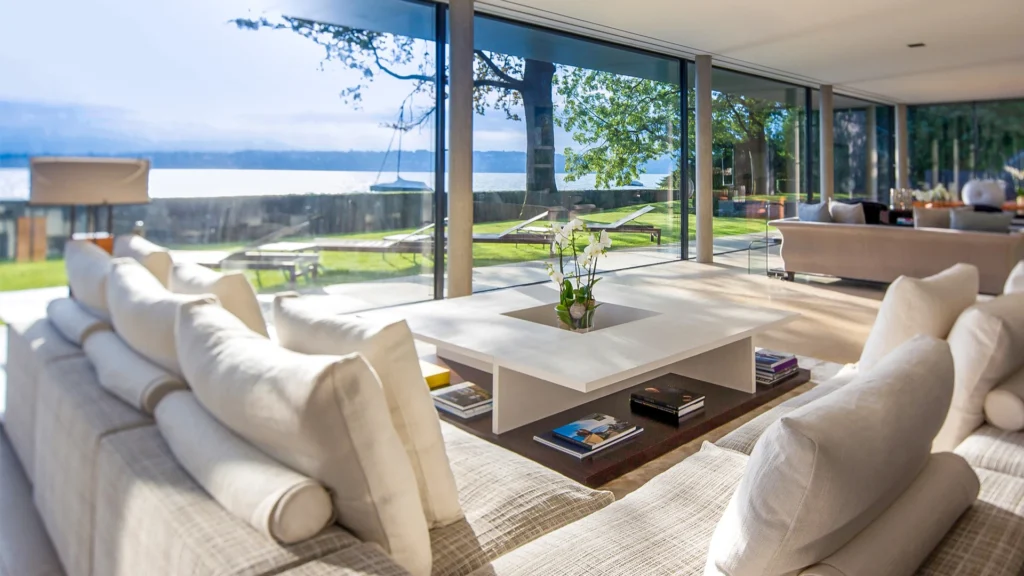
Orchestrating Perspective
Positioning sofas toward the panorama in Geneva lakefront homes is not a decorative decision; it is an architectural stance. It signals respect for landscape, mastery of proportion, and commitment to experiential design.
A meticulously considered living room seating arrangement transforms glass walls into living canvases. Within the framework of luxury waterfront interior design, furniture becomes both anchor and lens—grounding the room while directing the gaze outward.
For international design professionals and cultivated homeowners alike, the lesson is clear: in waterfront residences of this caliber, the view is the protagonist. Every sofa, every armchair, every subtle angle must honor that role—allowing Lake Geneva to remain the ultimate focal point, framed in elegance and lived in with intention.